
Plastic Saree Box Manufacturer in India: Complete Buying Guide
How to choose a plastic saree box manufacturer in India: PET and PP formats, measured sizes, decoration, samples and the questions to ask.
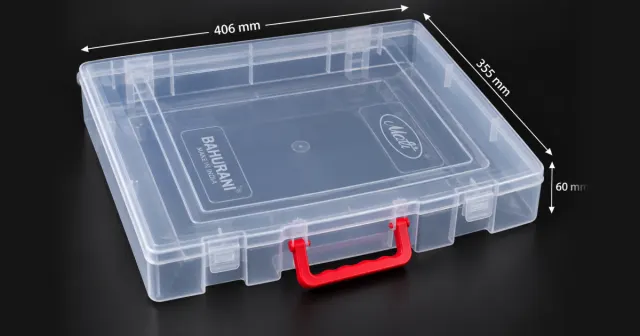
In this guide
- The three formats a saree box manufacturer moulds
- What injection moulding puts into the part
- Read trade sizes against measured millimetres
- What a saree box range should offer
- Decoration: decide it before the quote, not after
- What to ask any supplier before the first order
- Storage advice that should shape the choice
- Where the saree trade sits
- Questions buyers ask
- Getting a quote
Most saree packaging is chosen in a few minutes at a counter and then lived with for a year. The box has to protect the fabric, survive a courier run, stack on a shelf and still look worth the piece inside it.
This guide is about choosing the supplier, not just the box: the three formats that get moulded in India, what injection moulding does and does not give you, why the trade size on the label is not the size you should order against, and the questions that separate a manufacturer who can repeat an order from one who cannot.
Key takeaways
- Three formats cover almost every saree requirement: clear PET crystal boxes for display, PP boxes with a carry handle, and PET zip pouches for storage and gifting.
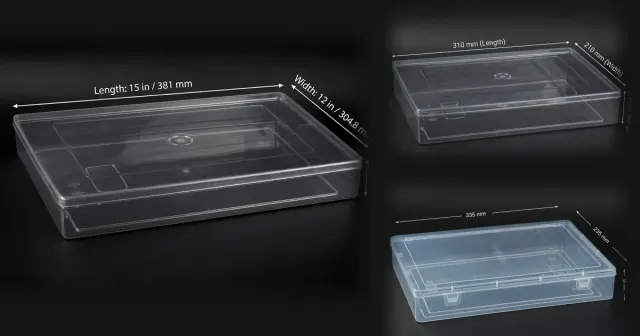
- Trade names such as "8 × 12" are approximate. Order against the measured millimetres, which differ between parts of the same nominal name.
- Injection moulding is what puts latches, a handle and an even wall into the part, and cooling alone takes 60–80% of the cycle, so repeatability is a process question.
- Before a first order, ask for the measured outer size, the material by name, a pre-production sample and the carton pack.
- Decoration decided at the quote stage is cheaper than a label applied later.
The three formats a saree box manufacturer moulds
Almost every saree packaging requirement in India is met by one of three moulded formats, and the difference between them is closure and clarity rather than shape.
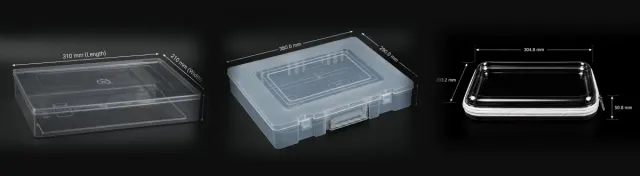
| Format | Material | Closure | Suits |
|---|---|---|---|
| Crystal box | Clear PET | Snap tabs on the lid | Retail display, gifting, courier despatch |
| Plastic box with handle | PP | Snap latches and a moulded handle | Carry-out at the counter, heavier sets |
| Crystal pouch | Clear PET | Fabric zip around the edge | Wardrobe storage, repeat opening, online orders |
Clarity is the visible difference. PET is moulded here in its clear, amorphous form, which is why the trade calls it crystal; opaque PET is the semi-crystalline version of the same polymer, as a review of PET in Environmental Chemistry Letters sets out. PP moulds translucent rather than glass-clear, so the weave shows through softened.
Which one to buy is a separate decision from who to buy it from, and it is covered in PET vs PP saree boxes and in the guide to crystal saree boxes. If you sell online or your customers reopen the pack often, read the crystal saree pouch guide as well.
What injection moulding puts into the part
Injection moulding is why a saree box has snap latches, a handle and the same wall thickness in every unit. The process runs in four steps — melting the raw pellets, injecting the melt into the mould cavity, cooling until the part solidifies, and ejecting it — and cooling alone accounts for 60% to 80% of the total cycle time, according to a review in Materials.
That matters commercially, not just technically. A part that is rushed out of the tool before it has cooled evenly is the part that arrives slightly warped, and the lid that will not sit down flat on the base. When you reorder next season and the new lids do not fit last season's bases, this is usually where it started.
The tooling behind it is a long-term asset rather than a per-order cost. Hardened steel tools are expensive and slow to make, but that cost is redeemed over the large number of parts they produce, as a study in Micromachines puts it. A manufacturer that designs and maintains its own multi-cavity tools controls its own output; one that hires tooling in does not. Our seven-stage process, from resin inspection to palletised despatch, is set out on the manufacturing page.
Read trade sizes against measured millimetres
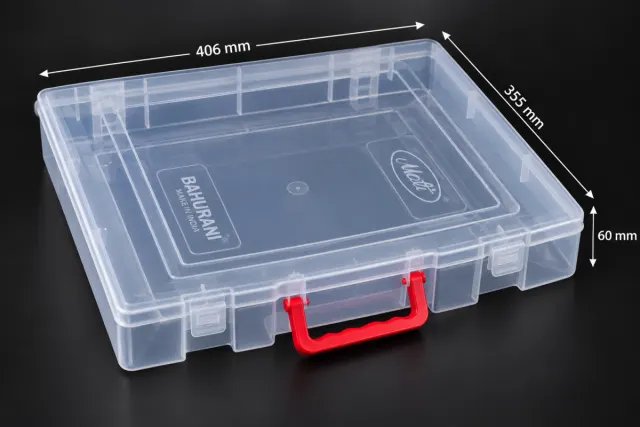
A saree box named 8 × 12 is not 8 inches by 12 inches, and three parts sharing that name are not the same size as each other.
| Part | Format | Measured outer size |
|---|---|---|
| CRS-101 | Clear PET crystal box | 310 × 210 × 50 mm |
| SR-101 | PP box | 315 × 215 × 45 mm |
| SRP-101 | Clear PET zip pouch | 304.8 × 230.2 × 50.8 mm |
The pouch is the clearest example: at 230.2 mm it is about nine inches across, not eight. None of this is a fault — the names are how the range is merchandised — but shelves, cartons and courier slabs are unforgiving, so the millimetres are what belong on the purchase order. Choosing a size works through the whole range, part by part.
What a saree box range should offer
A supplier's range tells you what they are set up to do. Ours runs to twelve saree parts across the three formats, which is enough to match most retail and packing requirements without commissioning a new tool.
Decoration: decide it before the quote, not after
Branding applied while the part is being made costs less and lasts longer than a label stuck on afterwards. Screen printing, dry offset printing and shrink sleeving are all done in-house here, and each has different artwork limits: screen printing suits bold single-colour marks, dry offset handles finer work on curved surfaces, and a shrink sleeve can carry full-surface artwork including photographs.
The practical point is timing. Decoration changes the quote, the lead time and sometimes the tool, so raise it in the first conversation rather than after the first sample is approved.
What to ask any supplier before the first order
Price is easy to compare and tells you the least. These are the answers that predict whether the second order will match the first.
| Ask for | Why it matters |
|---|---|
| The measured outer size in millimetres | Trade names are nominal; cartons and shelves are not |
| The material by name — PET or PP | It decides clarity, weight and behaviour in a hot godown |
| A pre-production sample | Your own saree, folded your way, in their box is the only real test |
| A repeat-order guarantee on the same tool | It is what keeps this season's lids fitting last season's bases |
| Decoration method and artwork limits | Screen, dry offset and shrink sleeve are not interchangeable |
| Carton pack and despatch point | Boxes per carton drives your freight cost more than unit price does |
Two answers deserve particular attention. If a supplier cannot tell you the measured size, they are quoting on a name. And if they will not send a sample before a bulk order, you are being asked to buy their consistency on trust.
Storage advice that should shape the choice
Conservation guidance for textiles is written for museums, but the physics is the same in a shop. The Canadian Conservation Institute notes that silk is sensitive to light and that sharp creases along fold lines can fracture fibres, which is an argument for padding folds and refolding stock that sits for months. It also warns that plasticisers migrating from PVC harm textiles — worth knowing, because PET and PP are not PVC, and the two are easily confused in a market that calls everything "plastic".
The other caution is humidity. The Smithsonian's Museum Conservation Institute points out that boxing fabric creates a microclimate that can be damper inside the box than the air outside it. In a coastal or monsoon market, that argues for stock rotation and for opening long-term storage occasionally, whatever the box is made of. The comparison with board is in plastic saree box vs cardboard box.
Where the saree trade sits
Scale explains why saree packaging is its own manufacturing niche. The Fourth All India Handloom Census recorded 35.22 lakh handloom workers and 28.20 lakh looms, and the saree is one of eleven articles reserved for handloom production under the 1985 Reservation Act, according to the Office of the Development Commissioner (Handlooms). Alongside that sits the powerloom trade: an MSME-DI profile of Surat district describes it as the synthetic capital of India with over 65,000 power looms, though that profile's figures run only to 2010-11 and the city has grown since.
For a packaging buyer the useful conclusion is narrow. Saree stock varies enormously in weight and bulk between handloom silk and synthetic georgette, so a range that only offers one depth will fit half of what you sell.
Questions buyers ask
Does a saree box have to be transparent?
No, but transparency is doing work in a shop. A clear box lets a customer identify a piece without opening it, which reduces handling of the fabric and speeds up picking from a shelf. Where presentation matters more than identification — gift packing, for example — a printed or sleeved box is the alternative.
Should I order the same size for every saree?
Rarely. Footprint is set by how you fold, and depth by what the piece weighs: a light cotton saree and a heavy Banarasi with zari work do not want the same box. Most retailers settle on two or three sizes.
What should I check when the first bulk delivery arrives?
Put a lid from the new batch on a base from your sample, and check the fit. Then measure two or three boxes against the drawing you were quoted. Those two checks catch most of what goes wrong in a repeat order.
Getting a quote
Send the saree type, the fold you use, the monthly quantity and the city it ships to — that is enough to recommend a format and size. You can see the full saree box range first, or send the requirement directly and we will come back with part options and a bulk price from the Dadra works.
Tell us the product, the quantity and the city it ships to.
We reply from the Dadra works with part options and a wholesale quote, usually within one business day.
Keep reading
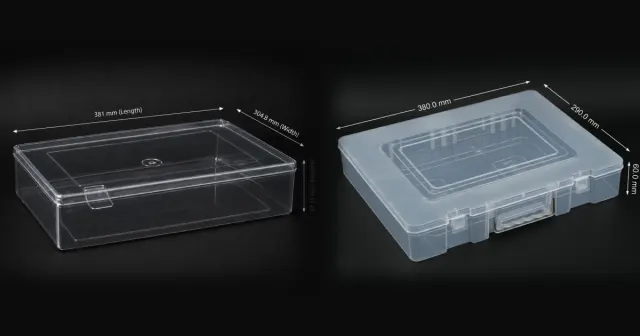
PET vs PP Saree Box: Which Is Better for Saree Packaging?
PET or PP for saree boxes? Compare clarity, weight, stiffness, heat behaviour and recycling codes, with the sizes each material is moulded in.
Plastic Saree Box Sizes: How to Choose the Right Size for Your Saree
Measure the folded saree, then match it: trade sizes, measured millimetres and depths for all twelve saree box and pouch parts, with a size table.
Crystal Saree Box: Benefits, Sizes & How to Choose the Right One
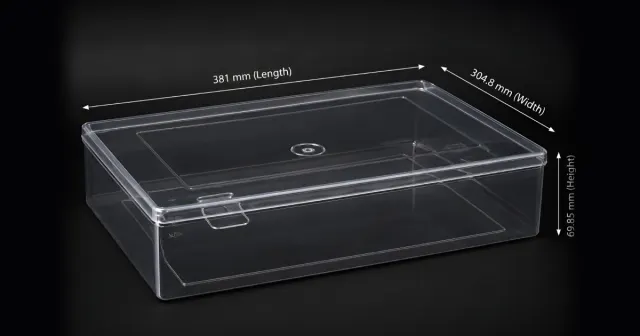
What a crystal saree box is, why clear PET suits retail display, and how to choose between five sizes from 7.5×12 up to 12×15×2.75 inches.