
PET vs PP Saree Box: Which Is Better for Saree Packaging?
PET or PP for saree boxes? Compare clarity, weight, stiffness, heat behaviour and recycling codes, with the sizes each material is moulded in.
In this guide
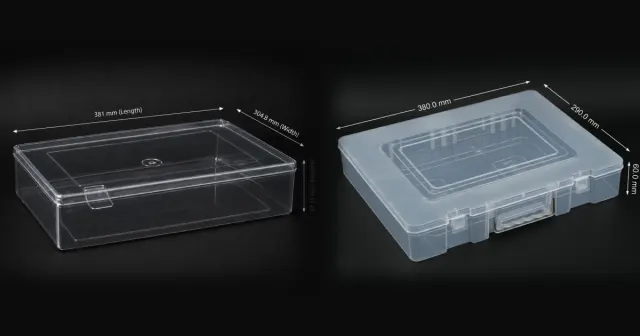
Two polymers dominate saree packaging in India, and shops rarely get told which one they are buying. PET is the glass-clear one the trade calls crystal. PP is the lighter, slightly frosted one that usually carries a handle.
The short answer: choose PET when the box is doing the selling, and PP when it is doing the carrying. Below is the evidence behind that, category by category, with the measured parts each material is moulded in.
Key takeaways
- PET moulds glass-clear, so the weave and border are identifiable without opening the box. PP is translucent and softens what is behind it.
- PP is the lighter polymer: about 0.90 g/cm³ against PET's 1.38 g/cm³, roughly 35% less dense.
- PP is the format that carries handles and latches in this range; PET is the format used for the slim display depths and the zip pouches.
- Both are on the conservators' list of stable plastics for textile storage. PVC is the one to avoid.
- Recycling codes differ: PET is 1, PP is 5, which matters to buyers reporting on packaging waste.
The comparison in one table
| PET (crystal) | PP | |
|---|---|---|
| Clarity | Glass-clear when moulded amorphous | Translucent, slightly frosted |
| Density (typical) | 1.38 g/cm³ | 0.90 g/cm³ |
| Handles and latches in this range | Snap tabs, no handle | Moulded handle and snap latches |
| Heat behaviour | Glass transition 67–80 °C | One clear grade softens under load at 90 °C |
| Resin code | 1 | 5 |
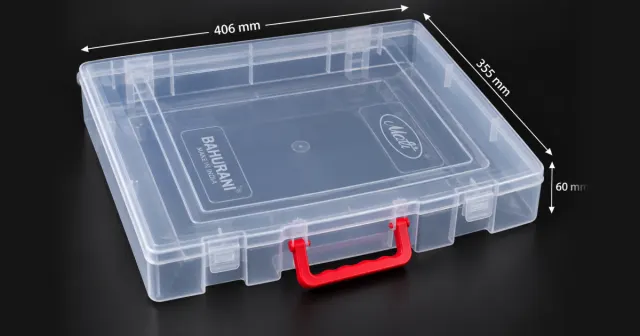
| Sizes moulded here | 7.5×12, 8×12, three 12×15 depths, three pouches | 8×12, 9×13, 12×15 Rajkumari, 14×16 Bahurani |
| Best at | Display, gifting, identification on the shelf | Carrying, heavier sets, everyday handling |
Which is clearer?
PET wins on clarity, and the reason is structural rather than a matter of grade quality. Clear PET is amorphous; opaque PET is semi-crystalline, as a review of the polymer in Environmental Chemistry Letters explains. That is also why "crystal" in the packaging trade means the clear material, which is the opposite of what the word suggests. Resin makers sell PET grades on exactly this property: Reliance's Relpet G5801 data sheet is marketed on its clarity and gloss.
PP can be moulded clear in random-copolymer grades — LyondellBasell markets its Moplen RP344NK for clear containers and rigid packaging — but in practice a saree box in PP reads as translucent. You can see that a saree is inside; you cannot always tell which one.
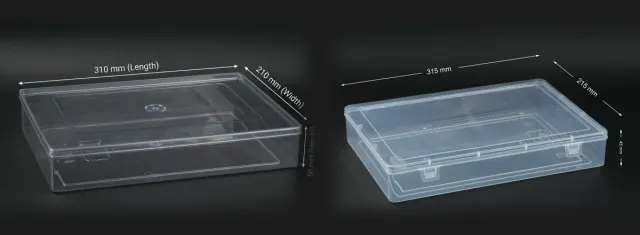
Verdict: PET, when the customer should be able to identify the piece without opening the box.
Which is lighter?
PP, by a wide margin. Typical density for PP is 0.90 g/cm³, from the Moplen RP344NK data sheet, against 1.38 g/cm³ for PET. These are typical values from two different sources rather than a controlled comparison, but the gap is large and consistent: PP is about 35% less dense.
Weight shows up on the freight bill and in the hand of whoever carries the bag out of the shop. For a 14 × 16 box holding a bridal set, that difference is felt.
Verdict: PP, whenever the box is carried rather than displayed.
Which handles heat better?
This one needs care, because the two materials are usually described with different measurements.
PET's glass transition — the temperature at which it stops behaving as a rigid glassy solid — is 67 °C for the amorphous form and 80 °C for semi-crystalline, per the same Environmental Chemistry Letters review. For PP, the clear grade cited above has a deflection temperature under load of 90 °C, and melting points vary by grade: a study in Polymers measured about 145 °C for a random copolymer and about 165 °C for a high-clarity impact PP.
None of these numbers describes a specific box, and neither material is anywhere near failing in a shop. They matter as a rough ordering: a closed vehicle or a tin-roofed godown in a Gujarat summer is a real environment, and PET softens at a lower temperature than PP does.
Verdict: PP on paper, though neither is at risk in normal retail storage.
Which is better for storing the saree?
A tie, and that is the useful finding. Conservation guidance from the US National Park Service lists polyethylene, polypropylene and inert polyester films among the safer plastics for long-term storage, and warns against PVC. PET is a polyester, so both materials on this page sit on the safe side of that line.
The same guidance notes that some conservators keep bags open because of possible condensation when humidity swings, and the Canadian Conservation Institute recommends padding folds and repositioning folded textiles periodically. Both apply whichever polymer you choose.
Verdict: tie. Neither material is the risk; sealed long-term storage in a damp season is.
Which is easier to recycle?
Both carry a resin identification code under IS 14534: PET is 1, PP is 5. Neither code is a claim about what actually gets recycled locally, and collection differs by city. For buyers who report on packaging under producer responsibility rules, the code is the identifier the paperwork uses; the rules themselves are covered in plastic saree box vs cardboard box.
Who should choose what
Boutiques and showrooms selling silk and designer pieces: PET. The box is part of the presentation, and a customer picking up a piece they already chose online should be able to see it without opening anything. The range runs from 7.5 × 12 up to three depths of 12 × 15 — see crystal saree boxes.
Retailers whose customers carry pieces home themselves: PP with a handle. The 12 × 15 Rajkumari and the 14 × 16 Bahurani exist for exactly this, and the weight difference is noticeable when the box holds a heavy set.
Online sellers and packers: PET, usually in the slimmest depth that fits, because courier slab pricing rewards a low profile. A crystal saree pouch is worth considering here too, since a zip survives repeat opening better than a snap lid.
Wholesalers stocking for other shops: both, in two or three sizes. Stock the clear boxes for display customers and the handled PP boxes for counter trade.
Verdict
| Category | Winner |
|---|---|
| Clarity | PET |
| Weight | PP |
| Handles and latches | PP |
| Heat behaviour | PP |
| Safe for textile storage | Tie |
| Display and presentation | PET |
Choose PET when the box sells the saree. Choose PP when it carries it. If you are still deciding on the size rather than the material, saree box sizes works through the measured footprints, and how to choose a manufacturer covers what to ask before the first order.
Tell us the saree type, the fold and the monthly quantity and we will suggest parts in both materials, or browse the saree box range first.
Tell us the product, the quantity and the city it ships to.
We reply from the Dadra works with part options and a wholesale quote, usually within one business day.
Keep reading
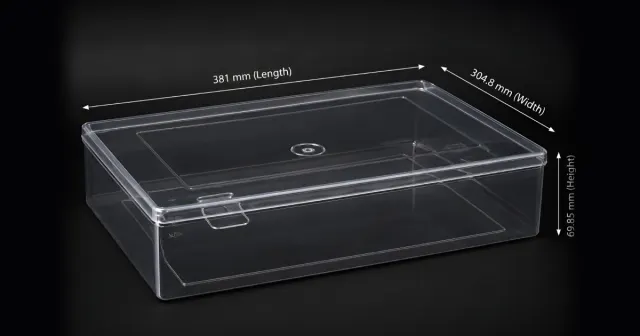
Crystal Saree Box: Benefits, Sizes & How to Choose the Right One
What a crystal saree box is, why clear PET suits retail display, and how to choose between five sizes from 7.5×12 up to 12×15×2.75 inches.
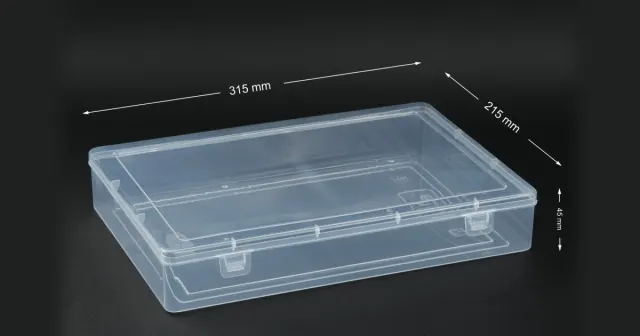
Plastic Saree Box vs Cardboard Box: Which Is Better?
Plastic or cardboard for saree packaging? Compare humidity, visibility, reuse, printing and India's plastic rules before placing an order.
Plastic Saree Box Manufacturer in India: Complete Buying Guide
How to choose a plastic saree box manufacturer in India: PET and PP formats, measured sizes, decoration, samples and the questions to ask.