
Plastic Saree Box Sizes: How to Choose the Right Size for Your Saree
Measure the folded saree, then match it: trade sizes, measured millimetres and depths for all twelve saree box and pouch parts, with a size table.
In this guide
Saree box sizes are sold under names like 8 × 12 and 12 × 15, and those names are approximations. Two boxes carrying the same name can differ by 20 mm, and a pouch named 8 × 12 measures about nine inches across.
So the reliable method is not to pick a name. It is to measure your own folded saree, then match that to the measured outer size of a part. This guide works through that, and ends with every size in the range in one table.
Key takeaways
- Footprint follows your fold; depth follows the weight and bulk of the piece.
- Measure a folded saree with its blouse piece included, then compare against measured millimetres, not trade names.
- The range runs from 291 × 197 mm up to 406 × 355 mm, in depths from 38.1 to 69.85 mm.
- At 12 × 15 inches, three depths share one footprint, so a shop can stock all three without changing its shelving.
- Always test with a real saree before a bulk order. A fold that springs back needs more depth than a measurement suggests.
Step 1: fold the saree the way you will sell it
Every shop folds differently, and the fold decides the footprint. Fold a representative piece the way it leaves your counter — including the blouse piece and any tissue you pack with it — and leave it to sit for a few minutes so the fabric relaxes.
Do not flatten it by hand to make it fit a box you already own. A saree compressed to fit will push the lid open in a carton, and the CCI warns that sharp creases along fold lines can fracture fibres under stress.
Step 2: measure three numbers
Take the length and width of the folded piece, then its height at the thickest point — usually where the blouse piece sits. Add clearance so the fold is not compressed: enough that the lid closes without you pressing it. A fold that barely fits in the shop will not fit after a courier has handled it.
Then compare those three numbers against the measured sizes below. A box whose footprint is slightly larger than the fold is right; one that matches exactly is too small.
If you pad folds with tissue for heavier pieces, measure with the tissue in place — it adds more height than people expect. Museum practice for textile storage is neutral-pH, unbuffered acid-free tissue rather than ordinary paper, and the same choice suits a saree that will sit in a box for a season.
Step 3: pick the footprint
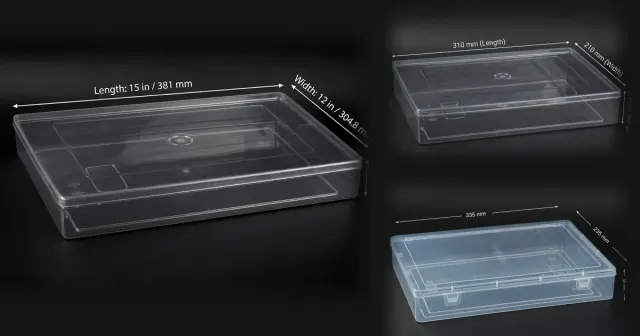
Six distinct footprints are moulded in this range, and they are easier to judge drawn to scale than listed as numbers.
Most retail stock lands on 310 × 210 or 381 × 304.8. The larger PP footprints exist for bridal sets and for shops whose fold is deliberately loose.
Step 4: pick the depth
Depth is where most size mistakes happen, because it is decided by fabric weight rather than by saree length. A cotton saree and a Kanjivaram of the same folded footprint need different clearance.
As a starting point, the guidance we give for the 12 × 15 crystal depths applies across the range: the slimmest depth takes one folded cotton, georgette or light synthetic saree, an unstitched length or a blouse-piece set; the middle depth takes a regular silk, designer or party-wear saree with its blouse piece; the deepest takes Banarasi, Kanjivaram or heavily embroidered pieces, and a full bridal set.
The slim depth is also the shelf and freight choice: more units per shelf and per carton. The deep one is protective: a heavy border pressed against a lid for months is what flattens zari work.
Every size in the range
| Part | Trade name | Format | Measured outer size | Material |
|---|---|---|---|---|
| CRS-102 | 7.5 × 12 | Crystal box | 291 × 197 × 47 mm | PET |
| CRS-101 | 8 × 12 | Crystal box | 310 × 210 × 50 mm | PET |
| CRS-103 | 12 × 15 × 1.50 | Crystal box | 381 × 304.8 × 38.1 mm | PET |
| CRS-104 | 12 × 15 × 2.25 | Crystal box | 381 × 304.8 × 57.15 mm | PET |
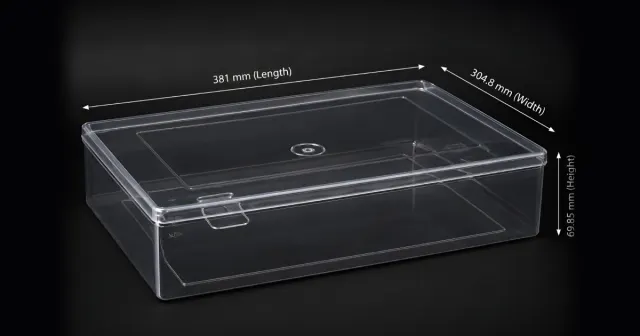
| CRS-105 | 12 × 15 × 2.75 | Crystal box | 381 × 304.8 × 69.85 mm | PET |
| SRP-101 | 8 × 12 | Zip pouch | 304.8 × 230.2 × 50.8 mm | PET |
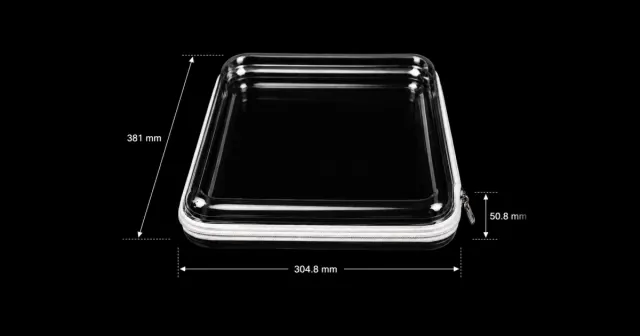
| SRP-102 | 12 × 15 | Zip pouch | 381 × 304.8 × 50.8 mm | PET |
| SRP-103 | 13.5 × 14.5 | Zip pouch | 368.3 × 342.9 × 50.8 mm | PET |
| SR-101 | 8 × 12 | Plastic box | 315 × 215 × 45 mm | PP |
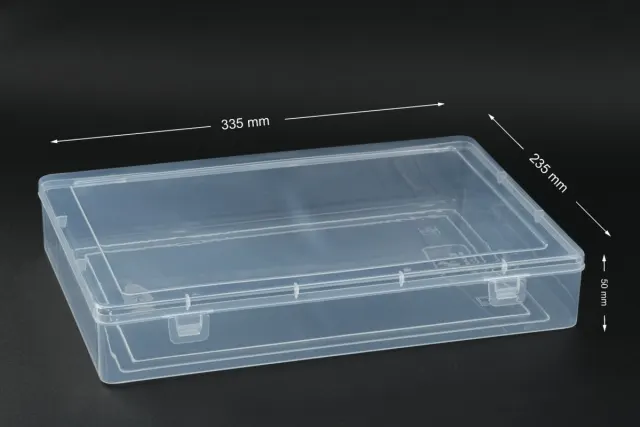
| SR-102 | 9 × 13 | Plastic box | 335 × 235 × 50 mm | PP |
| SR-103 | 12 × 15 Rajkumari | Plastic box, handle | 380 × 290 × 60 mm | PP |
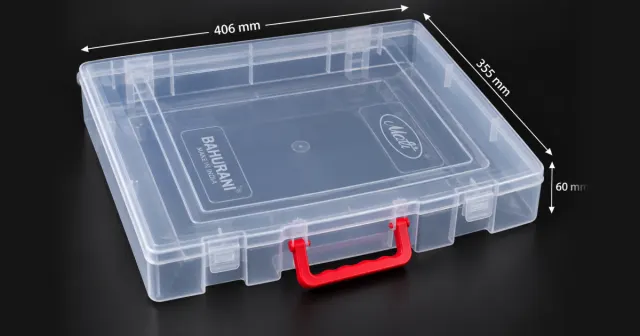
| BR-101 | 14 × 16 Bahurani | Plastic box, handle | 406 × 355 × 60 mm | PP |
Three parts are named 8 × 12 and none of them measures the same as the others. That is the argument for this table over the names.
Why sarees vary so much
There is no single saree size to design around. A cotton sari in the V&A's collection, made in Belgaum around 1855, is catalogued at 8 yards 18 inches by 1 yard 10 inches — roughly 7.77 × 1.17 m. Modern pieces differ by region, fabric and whether a blouse piece and petticoat travel with them.
Since the length is folded away, what reaches your box is the fold, not the saree. That is why the measurement in step 2 does more work than any general rule about saree dimensions.
Questions buyers ask
How many sizes should a shop stock?
Two or three covers most retailers: one slim box for light pieces and online despatch, one middle depth as the default carry-out, and a deep or handled box for bridal sets.
Should I size up to be safe?
Only slightly. Slack lets the fold shift in transit, which creases the piece across new lines. Aim for a box the fold sits in without being pressed, not one it slides around in.
Does the material change the size I need?
Not the footprint, but it changes what is available: the slimmest depth and the squarest pouch are PET, while the handled boxes are PP. PET vs PP saree boxes sets out the trade-off, and choosing a manufacturer covers ordering against measured drawings.
Confirming the size
Ask for one sample of the two footprints closest to your fold, pack a real saree in each, and close the lid without pressing. The one that closes cleanly is your size. See every size in the range or send us your folded measurements and we will name the parts that fit.
Tell us the product, the quantity and the city it ships to.
We reply from the Dadra works with part options and a wholesale quote, usually within one business day.
Keep reading
Crystal Saree Box: Benefits, Sizes & How to Choose the Right One
What a crystal saree box is, why clear PET suits retail display, and how to choose between five sizes from 7.5×12 up to 12×15×2.75 inches.
Crystal Saree Pouch: The Complete Guide for Saree Packaging
A crystal saree pouch is two clear PET shells joined by a zip. How it compares with a box, the three sizes, and the trades it suits best.
Plastic Saree Box Manufacturer in India: Complete Buying Guide
How to choose a plastic saree box manufacturer in India: PET and PP formats, measured sizes, decoration, samples and the questions to ask.