
Tamper-Proof Dates Box: Benefits & Best Packaging for Dates and Dry Fruits
Why dates and dry fruits need a tamper-evident box: storage science, FSSAI labelling, and how to choose between three 750 ml dates boxes.
In this guide
Dates are bought on trust twice over: the buyer trusts that nobody has opened the pack, and that the fruit inside is in the condition it was packed in. A tamper-proof dates box is the packaging answer to both — a moulded seal that shows first opening, and a barrier against the moisture and odours that quietly ruin dates in storage.
This guide covers what tamper evidence means, the storage science that decides how long a pack holds up, the labels Indian rules require, and how to choose between the three 750 ml boxes we mould.
Key takeaways
- India was the world's largest importer of dates by quantity in 2023, taking about 490,589 tonnes worth US$267 million.
- A tamper-evident pack shows visible evidence that it has been opened; that is the whole function.
- Dates absorb moisture and other foods' odours, so a well-sealed box does more than keep dust out.
- Storage life is governed by temperature: about a month at 21 °C against a year at 0 °C for semi-soft dates.
- Pre-packed boxes must carry FSSAI and Legal Metrology declarations, which affects whether you choose a plain or textured surface.
The market this packaging serves
India buys more dates than any other country by volume. World Bank WITS data compiled from UN Comtrade records India's 2023 imports of dates at 490,589,000 kg — about 490,589 tonnes — worth US$267.18 million, which was the largest quantity of any single importing country that year.
Most of that volume is repacked here for retail and gifting, which is where the box matters — particularly around Ramadan and Diwali, when dates move in gift packs rather than loose.
What "tamper-proof" actually means
The clearest definition comes from the US FDA, in a rule written for over-the-counter medicines rather than food: a tamper-evident package is one having one or more indicators or barriers to entry which, if breached or missing, can reasonably be expected to provide visible evidence to consumers that tampering has occurred.
Indian food law builds the same idea into its definition of a packed product. FSSAI's Labelling and Display Regulations 2020 define pre-packaged food as food placed in a package in such a manner that the contents cannot be changed without tampering it. The packaging regulations go further and require that food products be packed in a clean, hygienic and tamper-proof package or container.
On these boxes the mechanism is moulded into the part: a tab on the rim that has to be broken to lift the lid the first time. Because it is part of the tool rather than an applied seal, there is nothing to stick on during filling, and nothing that can be re-applied afterwards.
The storage science behind the seal
Dates are not shelf-stable in the way a biscuit is. Their behaviour depends on moisture, and moisture moves both ways through a poorly closed pack.
Dates are graded by ripeness stage and moisture: khalal at 45–85%, rutab at 30–45%, and tamar below 30%, according to the WFLO Commodity Storage Manual published by the Global Cold Chain Alliance. That manual also records how long semi-soft dates at 20–30% moisture keep at different temperatures.
The FAO puts the same point in terms of spoilage: a date at 30% moisture would spoil in a matter of days at room temperature, but keeps about four months at 5 °C and six months at 0 °C, according to its date palm products bulletin.
What goes wrong is specific, and packaging addresses most of it:
- Moisture gain or loss. The WFLO manual notes that if dates are stored wrapped in moisture-vapour-proof material, the surrounding air moisture does not have to be controlled.
- Odour pick-up. Dates absorb volatiles and take on the flavours of other commodities — a real risk in a warehouse holding spices.
- Sugar spotting. Sugar crystallising under the skin, worst in soft varieties at 22–33% moisture, and reversible by gentle heating.
- Souring, moulds and yeasts in dates that are too moist.
- Insects. The FAO names the fig moth, the dried fruit beetle and storage mites as the notorious pests.
For dry fruits and nuts packed alongside dates, the same logic applies with rancidity added: University of California guidance recommends packing shelled nuts in clean, moisture-free and odour-tight containers such as plastic or glass, and notes that room temperature speeds rancidity while 4 °C or below holds nuts for a year or more.
What Indian rules require on the pack
A pre-packed retail box carries two sets of declarations.
Under the FSSAI Labelling and Display Regulations 2020, a package needs the name of the food, the ingredient list where applicable, the veg or non-veg symbol, the name and complete address of the brand owner, the FSSAI logo and licence number, net quantity, retail sale price, consumer care details, a lot or batch number, the date of manufacture or packing with an expiry or use-by date, and country of origin for imported food. Bulk packages not meant for retail must be marked "NOT FOR RETAIL SALE".
The Legal Metrology (Packaged Commodities) Rules 2011 cover the commercial declarations: manufacturer, packer or importer details, common name, net quantity, month and year of manufacture, best-before or use-by date, MRP inclusive of all taxes, unit sale price, and a consumer care contact, as set out in the Department of Consumer Affairs compilation. Stickers may not be used to alter a declaration, except to reduce the MRP. That compilation is dated May 2022 and later amendments were not checked here, so confirm the current text before printing labels.
There is a product standard too. FSSAI's standard for dates sets a maximum moisture of 30.0%, ash insoluble in dilute HCl at 0.1%, blemished or damaged units at 5.0% and extraneous matter at 1.0%, and requires the product to be free from living insects, mould, dead insects, insect fragments and rodent contamination, per Chapter 2.3 of the Food Products Standards.
The labelling requirement has a packaging consequence: every declaration above has to fit somewhere legible, which is what decides between a plain and a textured surface.
Choosing between the three boxes
All three are 750 ml, moulded in PP with a tamper-evident closure. They differ in what they are for.
| Part | Finish | Measured | Best for |
|---|---|---|---|
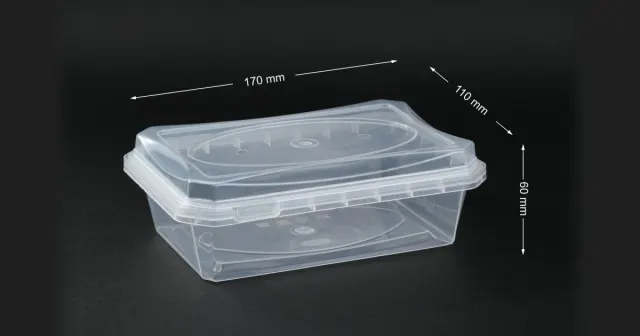
| DT-101 | Diamond-textured, transparent | 170 × 110 × 60 mm | Shelf appeal; the texture catches light and hides minor handling marks |
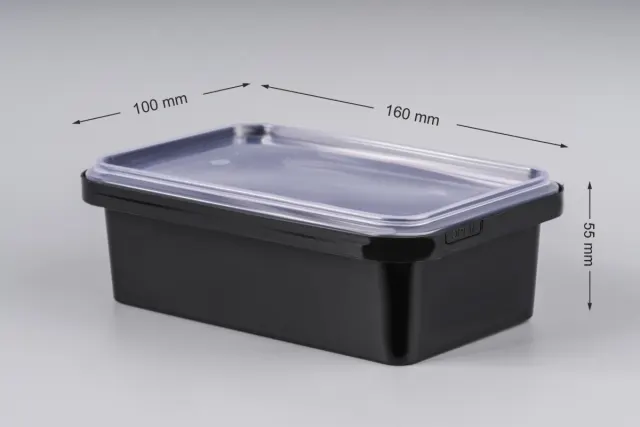
| DT-102 | Plain, transparent | 100 × 160 × 55 mm | Labelling and printing — a flat surface takes artwork cleanly |
| DT-103 | Black base, transparent lid | 100 × 160 × 55 mm | Premium and gift packs; fruit reads well against a dark ground |
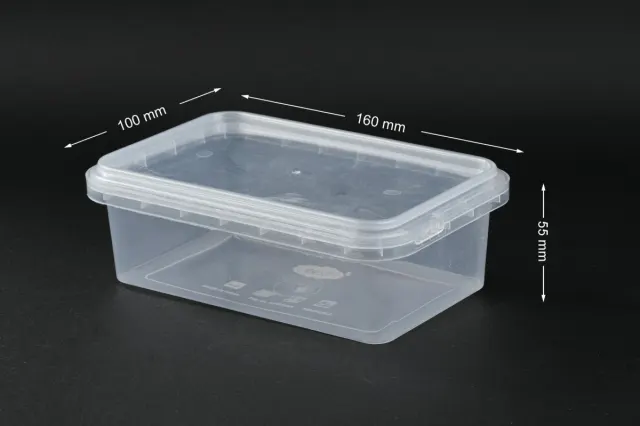
A practical way to decide: if your pack is sold under your own brand with printed artwork, start with the plain box. If it competes on a crowded shelf without much printing, the diamond texture does visual work. If it is a gift pack, the black base does.
The same reasoning extends to the rest of the dry-fruit range, where tamper-proof sweet and dry-fruit containers run from 250 gm to 1 kg.
Questions buyers ask
Does a tamper-evident box replace a shrink sleeve?
It can, for many retail packs. A moulded tab shows first opening without an extra process at filling. A sleeve adds a printed surface as well as a seal, so the choice depends on whether you need the artwork.
Will a plastic box keep dates fresh without refrigeration?
It slows moisture and odour exchange, which is a real benefit, but temperature still governs shelf life — roughly a month at 21 °C against a year at 0 °C for semi-soft dates. Packaging and cold chain work together.
Is 750 ml the right size for retail dates?
It is the common retail and gift size in this range. What matters more is headspace: a box filled to the rim bruises soft dates when the lid goes on.
Can these boxes be printed?
Yes — screen printing, dry offset and shrink sleeving are available, and the plain box is the easiest to work with. Printing inks for food packaging have their own standard, covered in the food grade containers guide.
Ordering
Tell us the fruit, the fill weight, whether the pack is retail or gift, and your monthly quantity. See the dates box range, read how to choose a container manufacturer, or send the requirement for samples from the Dadra works.
Tell us the product, the quantity and the city it ships to.
We reply from the Dadra works with part options and a wholesale quote, usually within one business day.
Keep reading
Food Grade Plastic Containers: How to Choose the Right Container for Your Business
What food grade means under FSSAI rules in India, which plastics suit hot, cold and frozen foods, and the documents to ask a supplier for.
Plastic Container Manufacturer in India: Types, Uses & Buying Guide
Types of plastic containers and what each trade uses, plus how to judge a manufacturer on tooling, moulding, decoration and packaging waste duties.
Restaurant Packaging Containers: Best Plastic Packaging for Takeaway & Food Delivery
Choose takeaway containers by menu item: leak resistance, stacking, capacities from 300 to 1000 ml, dosa boxes, and the rules that apply in India.