
Plastic Container Manufacturer in India: Types, Uses & Buying Guide
Types of plastic containers and what each trade uses, plus how to judge a manufacturer on tooling, moulding, decoration and packaging waste duties.
In this guide
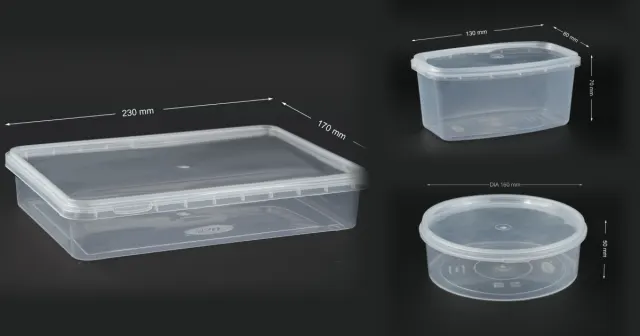
"Plastic container" covers a sweet shop's 500 gm mithai pack, a dairy's tamper-proof curd tub, a namkeen wholesaler's airtight drum and a restaurant's takeaway box. They are moulded on the same kind of machine and judged on completely different things.
This guide maps the main types to the trades that buy them, then covers what actually separates one container manufacturer from another: tooling, process control, decoration and the paperwork you will be asked for.
Key takeaways
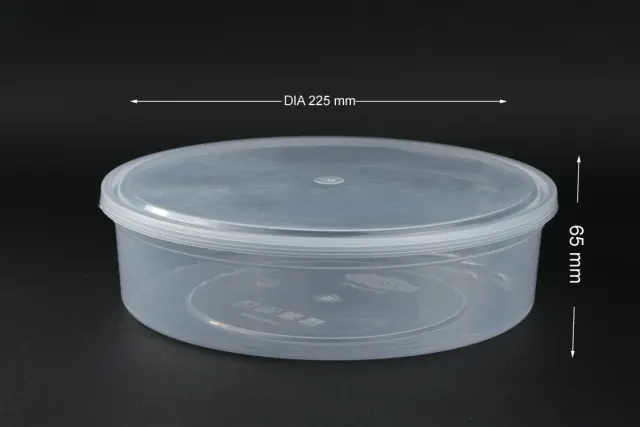
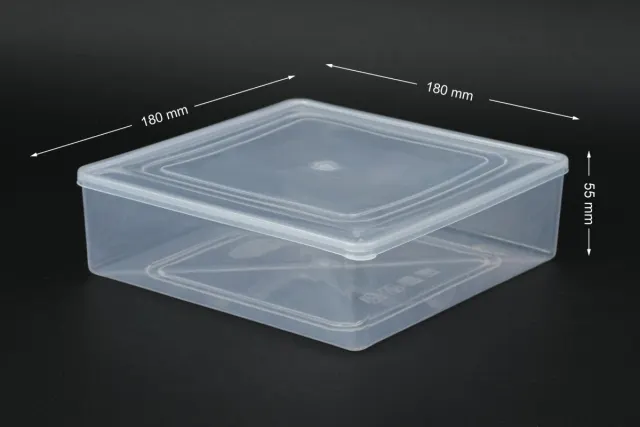
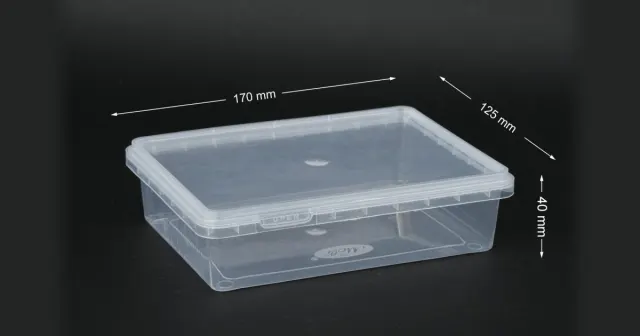
- Shape and closure follow the food: rectangular for sweets and takeaway, round for namkeen and Ghever, oval for ice cream, square for dairy.
- Tamper-evident closures matter wherever the pack changes hands after filling.
- Cooling is 60–80% of an injection moulding cycle, so consistency is a process question, not a promise.
- Tools are the real asset. A manufacturer who owns and maintains multi-cavity moulds controls lead time and repeatability.
- Brand owners carry packaging waste obligations in India, so ask about material and recycled content before you commit to artwork.
The main types, and who buys them
| Family | Typical parts | Capacity | Bought by |
|---|---|---|---|
| Sweet containers | Rectangular, plain or tamper-proof | 250 gm to 1 kg | Mithai shops, confectioners, dry-fruit packers |
| Ghever containers | Round, deep | 2000, 2500, 4000 ml | Sweet shops, seasonal makers |
| Dairy and ice cream | Square and oval, tamper-proof | 250 ml to 1200 ml | Dairies, ice-cream brands, frozen dessert makers |
| Namkeen containers | Round, wide mouth, tamper-proof | 1000, 1500 ml | Snack manufacturers, farsan shops, retailers |
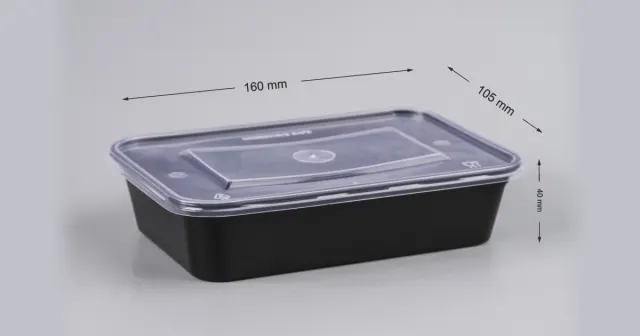
| Restaurant packs | Rectangular, black base, clear lid | 300 to 1000 ml | Restaurants, cloud kitchens, caterers |
| Dosa boxes | Square and triangular | By dosa count | Tiffin services, South Indian kitchens, QSRs |
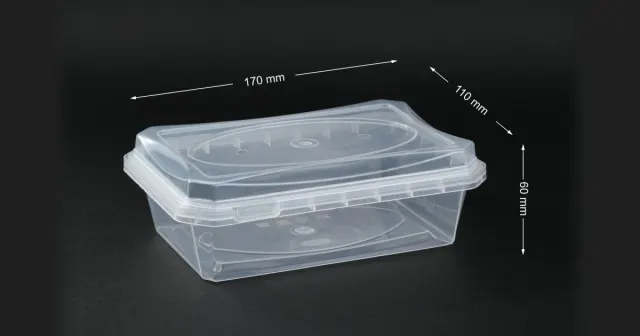
| Dates boxes | Rectangular, tamper-evident | 750 ml | Dates importers, dry-fruit packers, gift packers |
Two patterns run through that table. Shape follows the product: a round tub suits a scoopable or pourable product, a rectangle suits stacked pieces and a shelf. And closure follows the risk: anything that travels between the filler and the buyer benefits from a tamper-evident seal.
How the container is made, and why that shows
Injection moulding runs in four steps: melting the raw pellets, injecting the melt into the mould cavity, cooling until the part solidifies, and ejecting it. Cooling alone takes 60% to 80% of the cycle, according to a review in Materials.
That single fact explains most quality complaints about moulded containers. A cycle cut short leaves a part that has not set evenly, and an unevenly set part is one whose lid no longer seats the same way. When a buyer says "this batch doesn't seal like the last one", the cause is usually cycle discipline rather than material.
The economics sit in the tool. Hardened steel moulds are expensive and slow to produce, but that cost is redeemed across the large volumes they run, as a study in Micromachines puts it. Multi-cavity tools produce several parts per shot, which is what makes bulk food packaging affordable. A manufacturer who designs and maintains tools in-house — as we do at the Dadra works, across 45 live tools — can correct a fit problem at source; one who rents capacity has to negotiate for it.
Machine choice matters for cost rather than quality. ENGEL, which builds injection moulding machines, claims all-electric machines can more than halve power consumption on average, and cut it by up to 67% depending on application and machine. That is the manufacturer's own figure, and worth reading as such — but energy is a real share of a moulder's cost base, and an all-electric floor is a reasonable thing to ask about.
Our seven-stage process — raw material inspection, design and DFM, tooling, moulding, decoration, quality control and despatch — is documented step by step.
Matching the container to the food
Material and closure should be chosen against the product, not the price list.
- Hot or warm filling. Temperature behaviour differs sharply between polymers and matters most here; food grade plastic containers covers what PP and PET each tolerate.
- Frozen and cold chain. Impact resistance at low temperature is the property to ask about. PP homopolymer performs poorly in the cold, while copolymers containing a dispersed rubber phase improve low-temperature impact substantially, per research in the International Journal of Molecular Sciences.
- Dry snacks and namkeen. A wide mouth and an airtight closure matter more than clarity.
- Sweets and gifting. Presentation and a tamper-evident seal, with printing decided early.
- Delivery and takeaway. Leak resistance and stacking; see restaurant packaging containers.
Decoration, and when to raise it
Screen printing, dry offset printing and shrink sleeving are done in-house here, and each suits different artwork: a bold single-colour mark, finer work on a curved surface, and full-surface artwork respectively. Printing inks used on food packaging have their own standard in India, which is covered in the food grade guide.
Raise decoration in the first conversation. It changes the quote, the lead time, and occasionally the part.
Packaging waste obligations you should know about
If you sell a branded packed product, the packaging is your responsibility as well as your supplier's. The CPCB's guidance confirms that Category I covers rigid plastic packaging under the Extended Producer Responsibility guidelines notified on 16 February 2022, with micro and small brand owners exempted from the obligation.
Requirements have been tightening since. An analysis of the Plastic Waste Management (Amendment) Rules 2026 reports mandatory recycled content for Category I packaging beginning at 30% in 2025-26 and rising to 60% by 2028-29, with food-contact packaging able to carry a shortfall forward under conditions. Recycled material in food contact is separately restricted by FSSAI rules — the detail is in the food grade guide — so treat this as a question to put to your supplier rather than an assumption.
What to ask a container manufacturer
| Ask | What a good answer sounds like |
|---|---|
| Which polymer, by name, and which grade family | "Virgin food-grade PP" beats "food quality plastic" |
| Do you own the tool? | In-house design and maintenance, with cavity count stated |
| Capacity and measured dimensions | Both, in writing, before the sample |
| Tamper evidence, if the pack needs it | How the seal shows first opening |
| Decoration options and artwork limits | Method named, with the coverage each allows |
| Documents supplied with a bulk order | Material declaration, and what testing they can evidence |
| Carton pack and despatch | Units per carton and the despatch point |
Questions buyers ask
What minimum order should I expect?
It varies with the part and the decoration, because a printed run carries setup that a plain one does not. We keep a low minimum for a first order so a buyer can trial a part before committing to volume — ask for the figure against the specific part you want.
How long does a new custom container take?
A stock part is a stock part. A new one is a tooling project: design and DFM review, tool cutting, sampling, then production. The tool is the long pole, which is why most buyers start from an existing part and adapt decoration instead.
Can one supplier cover several families?
That is the practical advantage of a broad range. A sweet shop that also sells dry fruits and runs a counter for takeaway can order mithai packs, dates boxes and fast-food containers on one despatch instead of three.
Starting an enquiry
Tell us the product, the fill quantity, whether it needs a tamper-evident seal and the city it ships to. That is enough for us to suggest parts and quote. Browse the full catalogue or send the requirement to the Dadra works.
Tell us the product, the quantity and the city it ships to.
We reply from the Dadra works with part options and a wholesale quote, usually within one business day.
Keep reading
Food Grade Plastic Containers: How to Choose the Right Container for Your Business
What food grade means under FSSAI rules in India, which plastics suit hot, cold and frozen foods, and the documents to ask a supplier for.
Restaurant Packaging Containers: Best Plastic Packaging for Takeaway & Food Delivery
Choose takeaway containers by menu item: leak resistance, stacking, capacities from 300 to 1000 ml, dosa boxes, and the rules that apply in India.
Tamper-Proof Dates Box: Benefits & Best Packaging for Dates and Dry Fruits
Why dates and dry fruits need a tamper-evident box: storage science, FSSAI labelling, and how to choose between three 750 ml dates boxes.