
Restaurant Packaging Containers: Best Plastic Packaging for Takeaway & Food Delivery
Choose takeaway containers by menu item: leak resistance, stacking, capacities from 300 to 1000 ml, dosa boxes, and the rules that apply in India.
In this guide
- Why the packaging decision got bigger
- What goes wrong between the kitchen and the door
- Matching the container to the menu
- Why so many delivery containers have a black base
- The rules that apply to takeaway packaging in India
- What to tell customers on the pack
- Buying checklist for a kitchen
- Questions buyers ask
- Ordering for a kitchen
A delivery order is handled far more than a dine-in plate: filled, sealed, bagged, carried on a bike, stacked against other orders, tilted at every turn and opened twenty to forty minutes later. The container is the only thing protecting the food through all of that, and it is also the first thing the customer sees.
This guide is about choosing containers for that journey — which shapes suit which menu items, what actually causes leaks, and which Indian rules apply to takeaway packaging.
Key takeaways
- Match the container to the dish: rectangular packs for rice and dry items, deeper packs for gravies, dosa boxes sized by dosa count.
- Leaks are usually a lid-fit problem, which is a moulding consistency problem.
- Rectangular shapes stack in a delivery bag more reliably than round ones.
- India's single-use plastic ban names items such as cutlery, plates, cups and trays; rigid takeaway containers are not on that list, and state rules differ.
- Tell customers to reheat only in containers labelled for microwave use.
Why the packaging decision got bigger
Delivery is now a serious share of Indian restaurant revenue, and the numbers reported by the two large platforms show the scale.
Swiggy reported food delivery gross order value of ₹9,005 crore for the quarter, up 22.6% year on year, with 18.3 million monthly transacting users, in its results announcement. Eternal's food delivery net order value for the same quarter was reported at ₹9,757 crore, up 18.8%, in coverage of its results. Looking further out, the National Restaurant Association of India expects the food services industry to reach ₹7,76,511 crore by 2028 at 8.1% compound growth.
For a kitchen, the practical consequence is simple: packaging is no longer an afterthought bought on price alone, because a leaked order costs a refund, a rating and sometimes the customer.
What goes wrong between the kitchen and the door
Four things, in roughly this order of frequency.
The lid lets go. Either the fit was never right, or it varies between batches. This is a moulding consistency issue, and it is why sample testing with your own dishes matters more than a spec sheet.
Gravy finds the seam. A container filled to the brim with a thin curry will find any weakness when the bag tilts on a bike.
The stack collapses. Round tubs stack badly beside rectangles; a bag packed with mixed shapes shifts.
The food arrives wrong, not spilled. Crisp items go soft, hot items sweat. That is a venting and material choice as much as a sealing one.
Matching the container to the menu
| Menu item | Container | Capacity from the range |
|---|---|---|
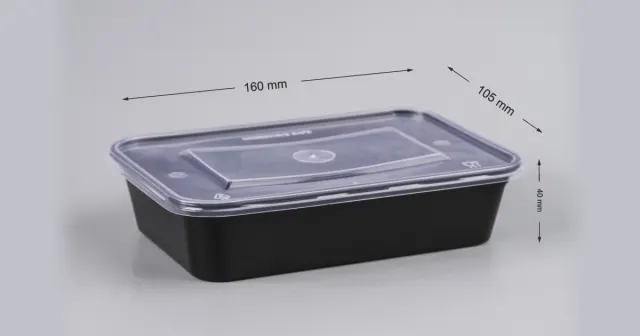
| Rice, biryani, pulao | Rectangular fast-food container | 650–1000 ml |
| Gravies, curries, dal | Rectangular with a secure lid, filled below the rim | 300–650 ml |
| Dry sabzi, starters, sides | Rectangular, shallow | 300–500 ml |
| Paper dosa | Dosa box, sized by dosa count | 3, 5 or 10 papers |
| Folded dosa, snacks | Triangle dosa box | 3 papers |
| Sweets with a meal | Tamper-proof sweet container | 250 gm–1 kg |
| Curd, raita | Square tamper-proof container | 250–500 ml |
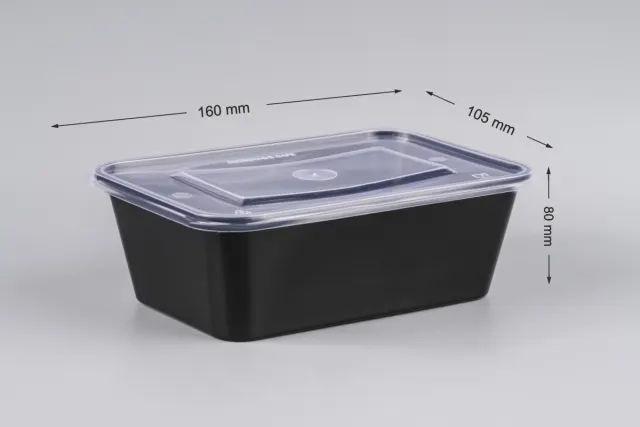
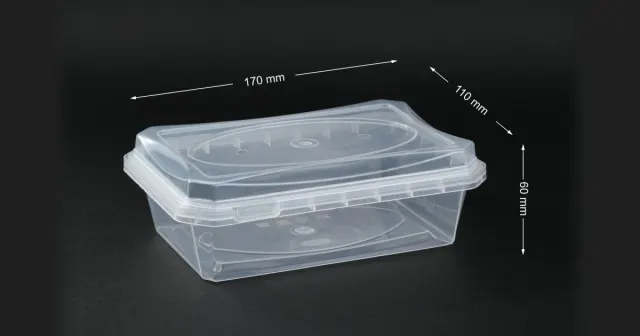
Our restaurant pack range runs 300, 500, 650, 750 and 1000 ml in one rectangular family, which is deliberate: a single shape across five capacities stacks cleanly in a delivery bag and needs one lid discipline from the kitchen staff rather than five.
Dosa boxes are the exception that proves the point: they are specified by how many paper dosas fit, not by millilitres, because that is how kitchens order them.
Why so many delivery containers have a black base
A black base with a clear lid is a presentation decision. Food photographs and reads better against an opaque dark ground than against a transparent one, and the lid still shows the customer what they are getting. It also hides staining from turmeric and oil better than a clear base does over repeated reuse by the customer.
The rules that apply to takeaway packaging in India
Three layers, and they are often confused with each other.
The single-use plastic ban. From 1 July 2022, a list of items was banned, including plates, cups, glasses, cutlery such as forks, spoons and knives, straws, trays, wrapping or packing films around sweet boxes, stirrers, and plastic or PVC banners under 100 micron, per the Gazette notification of 12 August 2021. Rigid takeaway containers are not named on that list. Note that trays are, which has caused confusion — a clarification reported in the trade press said plastic cups and trays used for packaging products fall under producer responsibility rules rather than the ban, and are treated as single-use commodities when not used for packaging.
State rules. These differ and they bite. Maharashtra's notification of 23 March 2018 banned single-use disposable dishes, cups, plates, glasses, forks, bowls and containers, including disposable dishes and bowls used for packaging food in hotels. That is the original 2018 text; later amendments exist which we have not verified here, so check the current position with your local authority before relying on it. Tamil Nadu's G.O. (Ms) No. 84 of 25 June 2018 banned plastic sheets used for food wrapping, plastic plates, plastic-coated tea cups, tumblers, water pouches and straws, as reproduced in a Supreme Court judgment, while exempting plastic used to pack dairy products and oil.
Producer responsibility. If you sell packed food under your own brand, rigid plastic packaging is Category I under the EPR framework. The detail, including recycled content targets, is in the plastic container manufacturer guide.
None of this is legal advice. Rules change and enforcement is local; the point is to ask the question before you print 50,000 branded lids.
What to tell customers on the pack
Two pieces of guidance are worth printing or putting in the app description.
Reheating: use only containers labelled for microwave use. Clemson Cooperative Extension warns that single-use tubs such as margarine tubs and yoghurt bowls may melt, warp or let chemicals migrate into food when heated.
Leftovers: refrigerate within two hours, in containers no more than three inches deep so the food cools through, per University of Nebraska–Lincoln Extension citing USDA guidance.
Buying checklist for a kitchen
| Check | Why |
|---|---|
| Lid fit tested with your own gravy, not water | Viscosity and temperature change how a seal behaves |
| One shape family across capacities | Stacking in the bag, and one habit for staff |
| Capacity against your real portion | An overfilled 500 ml pack leaks; a half-empty 1000 ml pack slides |
| Material named — food-grade PP | See food grade plastic containers |
| Printing method and lead time | Branded lids take longer than plain stock |
| Units per carton and despatch point | Freight per container is a real cost at delivery volumes |
Questions buyers ask
How do I stop gravies leaking without double-bagging?
Fill below the rim, use a deeper pack rather than a fuller one, and test the lid with a hot, thin curry rather than cold water. If leaks persist across batches, the problem is fit consistency and it belongs with your supplier.
Can customers reuse these containers at home?
Many do. The guidance worth passing on is to reuse packaging only with foods similar in acidity, sugar and fat content to what was originally packed, and to check the pack for a microwave label before heating.
Should every takeaway container be tamper-evident?
Not every one, but the case is strongest for anything a rider carries sealed. A tamper-evident closure is how a customer knows the pack has not been opened in transit — the reasoning is in the tamper-proof dates box guide, which covers the same principle for retail packs.
Are black containers harder to recycle?
Colour affects sorting in some recycling streams. The resin code and local collection matter more; ask your supplier to state the polymer, which should be food-grade PP for this family.
Ordering for a kitchen
Send your top five dishes and the portion sizes, and we will suggest capacities from the rectangular family and the dosa boxes to go with them. See the restaurant pack range or send your menu details for samples from the Dadra works.
Tell us the product, the quantity and the city it ships to.
We reply from the Dadra works with part options and a wholesale quote, usually within one business day.
Keep reading
Food Grade Plastic Containers: How to Choose the Right Container for Your Business
What food grade means under FSSAI rules in India, which plastics suit hot, cold and frozen foods, and the documents to ask a supplier for.
Plastic Container Manufacturer in India: Types, Uses & Buying Guide
Types of plastic containers and what each trade uses, plus how to judge a manufacturer on tooling, moulding, decoration and packaging waste duties.
Tamper-Proof Dates Box: Benefits & Best Packaging for Dates and Dry Fruits
Why dates and dry fruits need a tamper-evident box: storage science, FSSAI labelling, and how to choose between three 750 ml dates boxes.