
Food Grade Plastic Containers: How to Choose the Right Container for Your Business
What food grade means under FSSAI rules in India, which plastics suit hot, cold and frozen foods, and the documents to ask a supplier for.
In this guide
"Food grade" is used loosely in the packaging trade and precisely in Indian law. A supplier can call a container food grade because it looks clean and smells of nothing. The regulations mean something narrower: a material that conforms to a named Indian Standard and does not transfer more than set limits of substances into the food it holds.
This guide sets out what the rules actually require, how to match a plastic to hot, cold or frozen products, and the documents worth asking for before a bulk order.
Key takeaways
- Under FSSAI's packaging regulations, plastics for food containers must conform to the Indian Standards listed in Schedule III — IS 10910 for polypropylene, IS 12252 for PET, IS 10146 for polyethylene.
- The overall migration limit is 60 mg/kg, or 10 mg/dm², tested per IS 9845, with no visible colour migration.
- Specific metals and phthalates have their own limits, from 0.04 mg/kg for antimony to 48 mg/kg for iron.
- BPA is associated with polycarbonate and epoxy can linings, which are different materials from PP and PET.
- Microwave only containers labelled for microwave use, and match any reused container to a similar food.
What "food grade" means under Indian rules
The Food Safety and Standards (Packaging) Regulations, 2018 set the baseline. Plastic materials used to make containers for packing or storing food must conform to one of the Indian Standards specifications listed in Schedule III, as the regulation text puts it — polyethylene under IS 10146, polypropylene and its copolymers under IS 10910, and PET under IS 12252, among others. The same regulations require food to be packed in a clean, hygienic and tamper-proof package or container.
Two migration rules follow from that.
Overall migration is capped at 60 mg/kg or 10 mg/dm² when tested per IS 9845, with no visible colour migration. That is the total of everything that moves from the container into the food.
Specific migration limits apply to named substances. These are the published figures, in mg/kg:
Two more rules in the same regulations are worth knowing: printing inks used on food packages must conform to IS 15495, and newspaper or similar material must not be used for storing or wrapping food.
One recent change concerns recycled material. The Food Safety and Standards (Packaging) First Amendment Regulations, 2025, published on 28 March 2025, opened the door to recycled PET in food packaging as and when standards and guidelines are notified by the Food Authority. This is a narrow allowance for PET, not a general permission for recycled plastics. Because regulations are amended, check the current text on the FSSAI site before relying on any of this commercially.
Which plastic for which food
The right polymer is decided by temperature and handling more than by the food itself.
| Use | Suits | Why |
|---|---|---|
| Sweets, dry fruits, namkeen at room temperature | PP | Rigid, light, takes a tamper-evident closure |
| Curd, paneer, shrikhand | PP with a tamper-evident lid | Pack integrity between dairy and buyer |
| Ice cream and frozen desserts | PP copolymer grades | Impact at low temperature is the limiting property |
| Reheated or hot-served food | Only containers labelled for microwave use | Not every rigid plastic tolerates it |
| Clear display packs | Clear PET or clear PP grades | PET is the clearer of the two |
Those uses map onto the ranges moulded here: sweet and dry-fruit containers, dairy and ice-cream tubs and namkeen containers.
Two material facts sit behind that table.
For cold chain, PP homopolymer has poor impact resistance at room and low temperatures, while copolymers containing a dispersed ethylene-propylene rubber phase — with a glass transition around −40 to −50 °C — improve low-temperature impact dramatically, according to research in the International Journal of Molecular Sciences. "PP" on a quotation does not tell you which; ask.
For heat, PET's glass transition is 67 °C for the amorphous form and 80 °C for semi-crystalline, per a review in Environmental Chemistry Letters. Clear PET is the amorphous one. That is the lower of the two thresholds on this page, and it is a reason to think carefully before putting hot food into a clear PET pack.
Resin codes, and what they do not tell you
The resin identification code stamped into the base is defined in India by IS 14534: 1 for PET, 2 for HDPE, 5 for PP. The code identifies the polymer for recycling. It is not a food-safety mark, not a quality grade and not a statement that a container is microwave-safe — those are separate questions.
BPA: what it is and where it is not
Bisphenol A is used to make polycarbonate, a hard clear plastic, and is found in epoxy resins lining some metal food and beverage cans, as the US FDA describes it. The FDA has amended its regulations so they no longer provide for BPA-based polycarbonate in baby bottles and sippy cups, while its stated position is that BPA is safe at the levels currently occurring in foods. In India, BIS revised the baby feeding bottle standard IS 14625 in 2015 to prohibit BPA in those bottles.
Polypropylene and PET are different polymers from polycarbonate. If a supplier's claim about BPA matters to your buyers, ask them to state the polymer and grade rather than repeating a marketing line — including ours.
Handling advice worth printing on your pack
Microwaving. Clemson Cooperative Extension's guidance is to use containers labelled for microwave use, and it warns that single-use tubs such as margarine tubs and yoghurt bowls may melt, warp or let chemicals migrate into food when heated. For packs customers reheat routinely, restaurant packaging containers covers the delivery case.
Leftovers. University of Nebraska–Lincoln Extension, citing USDA guidance, advises refrigerating food within two hours of cooking or being served, with food no more than three inches deep in each container so it cools through.
Reuse. University of Arkansas Cooperative Extension advises reusing packaging only with foods similar in acidity, sugar and fat content to the food originally packed.
What to ask a supplier
- Which polymer and grade? By name — "virgin food-grade PP", not "food quality plastic".
- Which Schedule III standard does it conform to? IS 10910 for PP, IS 12252 for PET.
- Can you evidence overall migration testing to IS 9845? Ask what testing exists and who did it.
- What ink is used for printing, and does it conform to IS 15495?
- Is the closure tamper-evident, and how does it show first opening?
- Any recycled content? With food contact, the answer needs to square with current FSSAI rules.
- Will you send a pre-production sample? Fill it with your own product and leave it a week.
That last one is the test that catches what paperwork does not: odour pick-up, a lid that loosens as the product settles, a label that will not stick to the surface.
Questions buyers ask
Is a thicker container always safer?
No. Wall thickness affects strength and cost, not food safety, which is a question of material and migration. An over-thick container costs more to buy and to ship.
Does a tamper-evident lid make a container food grade?
No. They are separate requirements: the material has to conform to its standard, and the pack has to be tamper-proof under the packaging regulations. A container can satisfy one and not the other.
Can I put hot mithai straight into a plastic container?
Ask your supplier for the material's temperature limits and let the product cool to the range they give. Clear PET softens at a lower temperature than PP does, and no container should be filled hotter than its material allows.
Choosing a container
Start from the food, the fill temperature and whether the pack leaves your premises sealed. Then ask for a sample of two candidate parts and test both with your own product. See the food container range, read the plastic container manufacturer buying guide for what to check in a supplier, or send us the product details for part recommendations from the Dadra works.
Tell us the product, the quantity and the city it ships to.
We reply from the Dadra works with part options and a wholesale quote, usually within one business day.
Keep reading
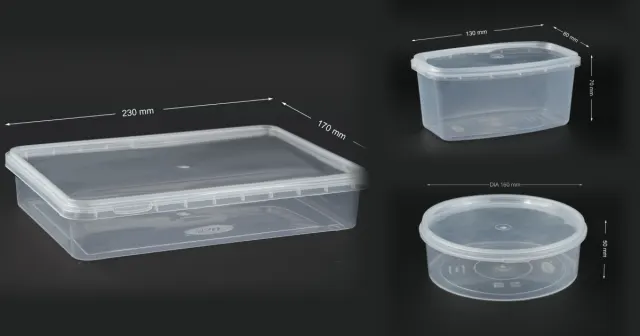
Plastic Container Manufacturer in India: Types, Uses & Buying Guide
Types of plastic containers and what each trade uses, plus how to judge a manufacturer on tooling, moulding, decoration and packaging waste duties.
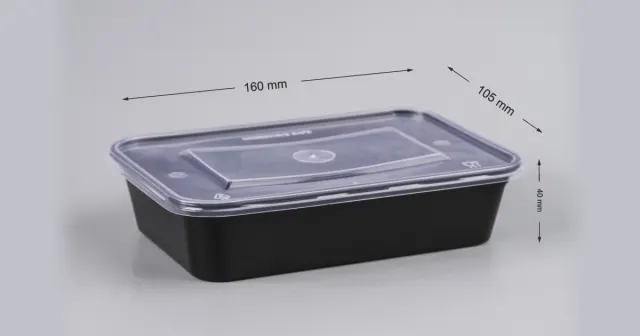
Restaurant Packaging Containers: Best Plastic Packaging for Takeaway & Food Delivery
Choose takeaway containers by menu item: leak resistance, stacking, capacities from 300 to 1000 ml, dosa boxes, and the rules that apply in India.
Tamper-Proof Dates Box: Benefits & Best Packaging for Dates and Dry Fruits
Why dates and dry fruits need a tamper-evident box: storage science, FSSAI labelling, and how to choose between three 750 ml dates boxes.