
Namkeen Packaging Containers: Keeping Farsan Crisp, Sealed and Shelf-Ready
How to pack namkeen and farsan in rigid containers: what makes it stale or rancid, tubs versus pouches, tamper evidence and FSSAI labelling rules.
In this guide
Namkeen is sold on the first bite. Sev, gathiya, chevda, bhujia and the rest of the farsan counter are judged on crunch and on a clean, fresh taste of the frying oil, and both are lost quietly in storage. The customer does not blame the humidity or the shelf. They blame the shop.
This guide is for namkeen and farsan makers and sweet shops choosing rigid round containers: what actually spoils namkeen, where a plastic tub helps and where a laminated pouch does the job better, how to choose between a low and a deep profile, and what the label has to carry under FSSAI's rules.
Key takeaways
- Namkeen fails in two ways: it picks up moisture and goes soft, and its frying oil oxidises and turns rancid.
- Moisture, oxygen, light and warmth drive both, so the pack and the storage conditions matter together.
- A high-barrier laminated pouch beats a rigid PP container on oxygen and light. The rigid container wins on crush protection, reclosing, display and reuse.
- FSSAI requires food to be packed in a tamper-proof package, and a pre-packaged namkeen label must carry date marking, a batch number, the FSSAI logo and licence number, and nutrition information including saturated and trans fat.
- Store packed namkeen cool, dry and out of direct light, and sell it in date order.
What spoils namkeen
Two separate processes are at work, and they need different defences.
Moisture pickup. Fried snacks are crisp because they are dry. In a University of Minnesota study, potato chips, popcorn, puffed corn curls and saltines held at different humidities became unacceptable to a sensory panel once their water activity reached the range of 0.35 to 0.50. Namkeen was not tested, but it is the same kind of fried, low-moisture snack.
Rancidity of the frying oil. A training deck on besan namkeen packaging published by NIFTEM puts it plainly: namkeen has a high oil content, so it goes rancid faster when left open; the oil oxidises on exposure to oxygen, changing flavour, taste and aroma; and the product also absorbs moisture and loses its crispness. The same deck names four factors that govern the shelf life of stored food: temperature, humidity, oxygen and light.
A little oxidation goes a long way. A University of Massachusetts Amherst review of lipid oxidation in low-moisture foods describes unsaturated fatty acids breaking down into volatile compounds that produce off-aromas associated with rancidity, many detectable at parts per million or even parts per billion. It also notes that swapping saturated for unsaturated fats makes the same oxidative shelf life hard to keep, so the frying oil matters as much as the pack.
A 2025 study in Discover Food measured this on a namkeen. Packed extruded namkeen was stored at 37 °C, and after two months the peroxide value, a marker of oxidation, had risen from 3.1 to 7.54 mM peroxide/g in LDPE packs, with a much smaller rise in laminated aluminium pouches. The authors found the aluminium laminate gave better moisture control, while LDPE was less effective at keeping moisture out, particularly under fluctuating conditions.
What the pack has to hold back
Put those together and a namkeen pack has three jobs: keep water vapour out, keep oxygen away from the oil, and keep light off the product. No single plastic does all three equally well, which is the honest starting point for comparing a tub with a pouch.
The figures come from a comparison table in a 2020 review in Materials. Polypropylene, the usual material for rigid food tubs, has an oxygen permeation of 1.5 against 0.04 for PET, roughly 37 times higher, but it is the best of the three on moisture vapour. The same table lists PP's transparency as poor and PET's as excellent, which matters for a display pack.
Aluminium sits in a different class. A review by researchers at ICAR-National Dairy Research Institute states that aluminium foil is impermeable to moisture and gas at a minimum thickness of 15 microns, that light transmission is negligible for foil and less than 10% for metallised paper, and that metallised films are used for bakery products, snacks and certain food powders. It adds that foil made from recycled aluminium usually contains pinholes.
Rigid containers or laminated pouches: an honest comparison
For long shelf life on its own, a well-made high-barrier laminate is the stronger pack. The NIFTEM deck lists the laminates commonly used for namkeen packets, including polyester/metallised polyester/LDPE and polyester/aluminium foil/LDPE. A heat-sealed pouch with a foil or metallised layer gives oxygen and light a far harder path than an unlined PP tub with a push-on lid. For months in a warehouse and on a shelf, that is where the evidence points.
A rigid container earns its place on other grounds:
| Need | Rigid round container | High-barrier laminated pouch |
|---|---|---|
| Oxygen and light barrier | Lower, unless lined or sleeved | Higher, especially with foil or metallising |
| Moisture barrier | Good material, but the lid joint matters | Good when the heat seal is sound |
| Crush protection in transit and at home | Strong: holds shape under a stack | Weak: sev and gathiya break in a squeezed pouch |
| Reclosing after first use | Lid refits every time | Needs a zip, or a clip at home |
| Counter and gift display | Stands, stacks, shows the product | Lies flat or needs a stand-up gusset |
| Reuse by the customer | Can be kept as a storage tub | Rarely reusable |
| Tamper evidence | Moulded in, on tamper-evident parts | The heat seal itself |
FSSAI's packaging regulations make the crush point in general terms: packaging must withstand the mechanical, chemical or thermal stresses of normal transportation, and for flexible or semi-rigid containers an overwrap may be necessary. A tub of fine sev that arrives as crumbs has not done its job, however good its barrier figures are.
Two practical points narrow the gap. The chart figures are per unit thickness, so a thick container wall passes less than a thin film of the same polymer. On the other hand, a push-on lid is not a heat seal, and the joint between lid and base is a path that material figures do not describe. That is why a sample filled with your own product and left on your own counter tells you more than any datasheet.
One option is to use both: a laminated inner packet for shelf life, inside a rigid outer for the gift box, the festive hamper or the counter. The regulations allow for multilayer packs, provided the layer in contact with the food meets the packaging material requirements.
Tamper evidence for namkeen
The packaging regulations require food to be packed in a clean, hygienic and tamper-proof package or container, and the labelling regulations define pre-packaged food as food whose contents cannot be changed without tampering. For festive packs and stock sold through other shops, a tamper-evident closure is how the customer knows nobody has topped up, swapped or sampled the contents. How the moulded band works is covered in the tamper-proof dates box guide; the principle is the same for namkeen.
Choosing a profile: low or deep
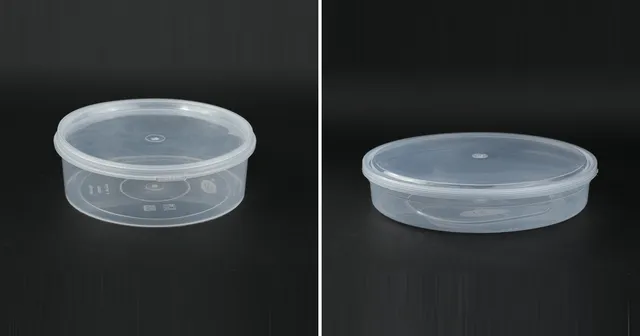
Our namkeen range is round, and the choice comes down to height and closure.
| Code | Capacity | Size | Closure |
|---|---|---|---|
| NK-101 | 1000 ml | — | Tamper-evident |
| NK-102 | 1500 ml | 225 mm dia × 60 mm high | Tamper-evident |
| NK-103 | 1500 ml | 225 mm dia × 45 mm high | Plain |
The low profile (NK-103, 45 mm) spreads the product across a wide, shallow base, shows more of it through the lid and stacks low. With a plain closure, it suits counter sale, gifting and packs that go into a sealed outer.
The deeper profile (NK-102, 60 mm) at the same diameter gives headroom, so the lid does not press on a heaped fill of chevda, and it adds a tamper-evident closure. It is the choice for packs that leave your premises sealed and sit on someone else's shelf. NK-101 (1000 ml) is the smaller tamper-evident option.
Sweet shops selling namkeen beside mithai can match it with the tamper-proof sweet containers in 250 gm, 500 gm and 1 kg. Confirm the polymer and grade for each part in writing before a bulk order; the questions to ask are in food grade plastic containers.
What the label has to carry
Pre-packaged namkeen falls under the Food Safety and Standards (Labelling and Display) Regulations, 2020. The points that most affect a farsan label:
- Date marking. "Date of manufacture or packaging" and "Expiry/Use by" must be declared and grouped together in one place. "Best before" may be added as optional information. For shelf lives of up to three months the date goes in DD/MM/YY form; above three months, month and year are enough, though DD/MM/YY is also allowed.
- Storage conditions. If the validity of the date depends on how the food is stored, those conditions must be declared, and storage conditions after opening may be given.
- Batch. A batch, lot or code number must be declared.
- FSSAI logo and licence number of the brand owner, plus the manufacturer's or packer's licence number if different.
- Veg or non-veg symbol, in the size the regulations specify.
- Nutrition information. Packages of food in which fats or oils are used as an ingredient must declare saturated fat and trans fat content, so fried namkeen is caught by this even where other exemptions apply.
- Net quantity and consumer-care details, which follow the Legal Metrology Act and its rules.
The two date terms differ: after "best before" the food may still be safe though its quality may have diminished; after "use by" or "expiry" it may not be safe and must not be sold. Set yours from your own storage trials, not a competitor's pack.
The packaging regulations add that printing inks must conform to IS 15495 and the printed surface must not touch the food. Dates and batch numbers change every run, so they usually go on a label or coder, while brand artwork can be printed on the container. The options, including screen printing, dry offset and shrink sleeves, are compared in the custom printed plastic containers guide.
None of this is legal advice; the regulations are amended, so check the current FSSAI compendium before finalising artwork.
Storage advice for the shop and the customer
The four factors in the NIFTEM deck translate directly into shop practice.
- Pack cooled product, so warmth and steam are not sealed in after frying.
- Keep stock cool. The deck notes that foods kept at 24 °C or lower stay edible for longer than commonly assumed. A stockroom beside the kadhai is the wrong place.
- Keep it dry. Close counter tubs fully between servings and keep cartons off damp floors.
- Keep it dark. Light degrades fats and oils, so keep display stock small and back-up stock in closed cartons.
- Sell in date order, oldest first.
For the customer, one line on the lid is enough: close after use, keep away from the stove, finish by the date shown.
Questions buyers ask
Will a rigid container keep namkeen fresh for six months?
The NIFTEM deck gives about six months for properly packaged namkeen, but that depends on the product, the oil, the pack and the storage conditions together. A plain PP tub is a weaker oxygen barrier than a foil laminate, so run your own trial at the temperature your stock will actually see before you print a date.
Can customers reuse the container for other food?
Some will. The guidance worth passing on, summarised in the food grade plastic containers guide, is to reuse packaging only with foods similar in acidity, sugar and fat content to the original.
Ordering namkeen containers
Send us your product list, typical pack weights and whether each pack leaves the shop sealed, and we will suggest parts from the round namkeen range and the sweet containers to match. New customers get a low MOQ on a first order, and samples come from our works at Dadra, Silvassa. See the namkeen containers, browse the sweet and dry-fruit range or send us your requirements.
Tell us the product, the quantity and the city it ships to.
We reply from the Dadra works with part options and a wholesale quote, usually within one business day.
Keep reading
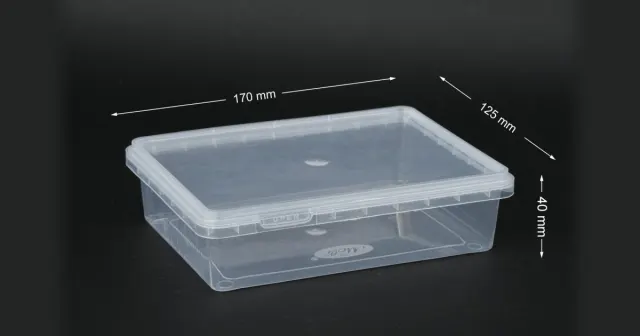
Food Grade Plastic Containers: How to Choose the Right Container for Your Business
What food grade means under FSSAI rules in India, which plastics suit hot, cold and frozen foods, and the documents to ask a supplier for.
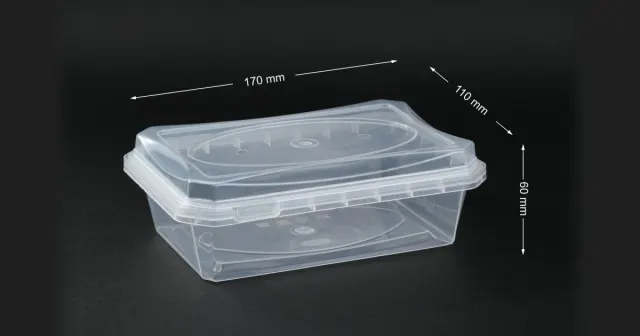
Tamper-Proof Dates Box: Benefits & Best Packaging for Dates and Dry Fruits
Why dates and dry fruits need a tamper-evident box: storage science, FSSAI labelling, and how to choose between three 750 ml dates boxes.
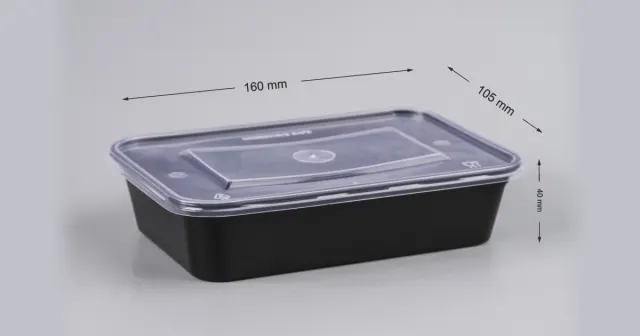
Restaurant Packaging Containers: Best Plastic Packaging for Takeaway & Food Delivery
Choose takeaway containers by menu item: leak resistance, stacking, capacities from 300 to 1000 ml, dosa boxes, and the rules that apply in India.