
Dosa Box Guide: Choosing Plastic Dosa Boxes for Takeaway and Delivery
How to choose a plastic dosa box: what 3, 5 and 10 paper means, why dosas go soggy in transit, matching depth to count, and packing chutney separately.
In this guide
- Why the dosa box deserves its own decision
- Why dosas go soggy in the box
- Venting, resting and lining
- What "3 paper", "5 paper" and "10 paper" mean
- Square or triangle: the four boxes compared
- Matching depth to the order
- Keeping chutney and sambar out of the box
- Stacking in the delivery bag
- Reuse and handling advice for customers
- Questions buyers ask
- Ordering dosa boxes
A dosa is the hardest thing on a South Indian menu to deliver well. Idli and vada travel happily; a paper dosa that left the tawa crisp can reach the customer limp, torn at the fold and sitting in its own steam. The box is not the only cause, but it decides how much of that damage happens.
This guide is for South Indian restaurants, cloud kitchens, tiffin services and caterers choosing a dosa box. It explains what "3 paper", "5 paper" and "10 paper" mean on a box, why dosas go soggy in transit, how to match box depth to the order, and how to keep chutney and sambar from undoing the rest.
Key takeaways
- A dosa is crisp because it is dry. Moisture from its own steam softens it, and a closed box traps that steam.
- The "paper" number on a dosa box is a capacity guide. Across our three 7×7 square boxes it works out to roughly 5.5 to 6 mm of depth per paper.
- Pick the shallowest box the order fits. Empty headspace lets the dosa slide; overfilling crushes the fold.
- Chutney and sambar travel in their own sealed containers, never inside the dosa box.
- Lining paper must be food-grade. FSSAI says newspaper must not be used to wrap food or soak up oil.
Why the dosa box deserves its own decision
Dosa is one of the most ordered dishes on Indian delivery apps. Swiggy's "How India Swiggy'd 2025" report, covering 1 January to 30 November 2025, put veg dosa at 26.2 million orders, fourth on the platform after biryani, burgers and pizzas. At breakfast alone, veg dosa was second only to idli, with 9.6 million orders.
A biryani container only has to hold rice and not leak. A dosa box has to keep a thin, crisp, fragile sheet in shape and dry for the length of a ride.
Why dosas go soggy in the box
A dosa is made by spreading fermented rice and black gram batter in a thin layer, 1 to 5 mm thick, on a heated plate, giving a product anywhere from semi-soft to crisp, according to a review in the Journal of Food Science and Technology. The crisp ones are the thin ones, and the crispness comes from having driven most of the water out on the tawa.
That dryness is what the box has to protect. Food scientists describe water as a plasticiser in crisp starch-based foods: as a crisp product takes up moisture, it moves from a brittle glassy state to a soft rubbery one and loses its crispness, and the change happens at a threshold called the critical water activity. A study of fish crackers, another crisp starch snack, put that threshold at about 0.41 to 0.49. A dosa is not a cracker, but the physics is the same: a little water back in the surface and the snap goes.
The water comes from the dosa itself. A hot dosa goes on giving off steam after it leaves the tawa. Inside a closed box, that warm, humid air meets the cooler lid, and once the lid is below the air's dew point, the temperature at which water vapour condenses, droplets form and fall back on the food. The problem is old enough to have its own patents. One from 1994 describes how, in conventional containers, steam from hot food cools and condenses and forms pools of moisture and oil that sit against the food.
So the three things that decide how soggy a dosa arrives are how much steam goes into the box, where it condenses, and whether that water can get back to the dosa.
Venting, resting and lining
Let the first steam go. The simplest control costs nothing: rest the folded dosa for a moment before the lid goes on, so the hottest burst of steam leaves in the kitchen rather than in the box. How long depends on your batter and the size of the dosa; time it with a test order rather than a rule.
Vented lids. A lid with small vent holes lets steam escape in transit instead of condensing on the underside. Our catalogue listings for the dosa range do not describe a vent, so if venting matters to your menu, ask for a sample and look at the lid, and ask the same of any supplier. A vent trades some heat for crispness, and it can let smell and a little oil out, so it suits dry dosas better than a masala dosa heavy with potato.
Paper lining. A sheet of food-grade butter paper or greaseproof paper under the dosa soaks up some condensate and oil before it reaches the crust, and gives the customer something clean to lift the dosa by. The paper must be made for food contact. FSSAI has said that under the Food Safety and Standards (Packaging) Regulations, 2018, newspaper should not be used to wrap, cover or serve food, nor to absorb excess oil from fried food. That rules out the old habit of a square of newsprint in the base.
What "3 paper", "5 paper" and "10 paper" mean
Our catalogue lists dosa box capacity in "papers": the 7×7 Big Dosa Box (10 Paper) is described for large paper dosas, the 7×7 Medium Dosa Box (5 Paper) for medium ones, and the 7×7 Small Dosa Box (3 Paper) for smaller paper dosas and mini dosas. The listings do not define the term further.
The figure is best read as roughly how many folded paper dosas the box takes. The three square boxes share one footprint and differ only in depth, and depth divided by paper count comes out close to constant.
Treat the number as a guide, not a guarantee. A thinner batter, a tighter fold or a filling changes the thickness of each dosa, so your count may differ from the label. Pack a few of your own and count before you order in bulk.
Square or triangle: the four boxes compared
| Box | Code | Size (mm) | Capacity | Suits |
|---|---|---|---|---|
| 7×7 Small | DB-103 | 180 × 180 × 18 | 3 papers | Single orders, mini dosas |
| 7×7 Medium | DB-102 | 180 × 180 × 28 | 5 papers | Two or three dosas, family orders |
| 7×7 Big | DB-101 | 180 × 180 × 55 | 10 papers | Bulk, catering, office and tiffin orders |
| Triangle | DB-104 | 220 × 155 × 25 | 3 papers | Folded paper dosas served as a cone or triangle |
"7×7" is the footprint in inches, near enough: 180 mm is just over seven inches. All four are listed as transparent.
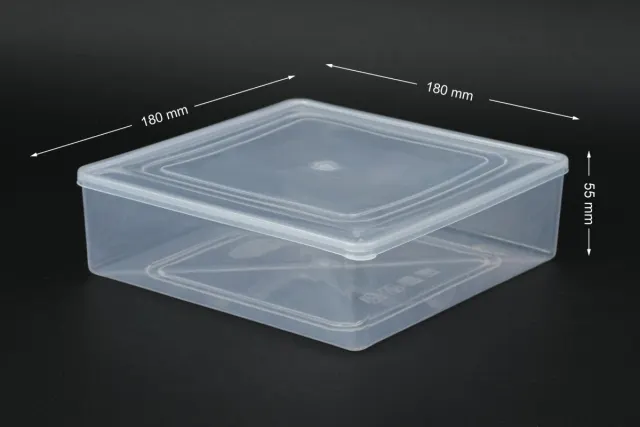
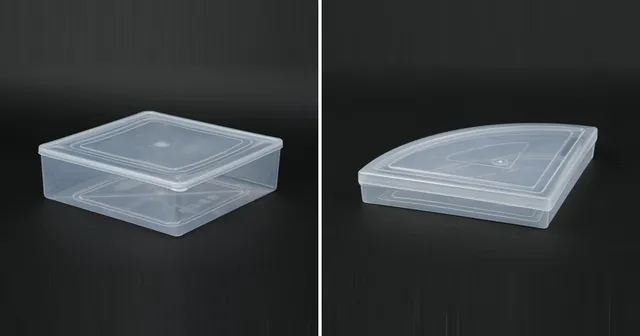
The square boxes suit dosas folded flat into quarters or rolled and laid side by side. Because all three share the 180 mm footprint, they stack on each other whatever the mix of depths in an order.
The triangle box is made for folded paper dosas; the listing notes that the shape helps position the food and reduces movement during delivery. It does not share the square footprint, so plan for it to sit on top of a stack rather than in the middle.
Matching depth to the order
The rule that follows from all this is simple: use the shallowest box the order fits.
Too much headspace means more air to hold steam and more room for a folded dosa to slide, open up and crack at the fold when the rider brakes. Too little is the other failure: a lid pressed down on a full box crushes the fold and squeezes out oil.
A practical way to set it up in a kitchen:
- Map your menu to boxes once. One plain or masala dosa goes in the small or triangle box; two to three in the medium; larger orders in the big box.
- Put the mapping on a card at the packing station so the choice is not made by whoever is on shift.
- For a set, such as dosa with idli and vada, pack the dosa on its own and the rest in a separate container. Idli and vada are softer and wetter, and will steam the dosa if they share its box.
Keeping chutney and sambar out of the box
Coconut chutney and sambar are the fastest way to ruin a crisp dosa: they are mostly water and they travel hot. Pack them in their own sealed containers, filled below the rim, and place them in the bag beside the dosa box, not on top of it, so a weeping lid does not drip onto the dosa.
Choosing and filling those containers is covered in the restaurant packaging containers guide, which also covers the Indian rules on takeaway packaging and our rectangular restaurant pack range of 300 to 1000 ml containers.
Stacking in the delivery bag
- Flat and level. Dosa boxes should lie flat. On its side, a folded dosa slides to one wall and tears.
- Dosa on top. Heavy gravy containers go at the bottom, where their weight is stable and any leak cannot run down onto the dosa.
- One footprint. Several square dosa boxes of any depth make a single stable column because they share a footprint. The triangle box goes on top.
Reuse and handling advice for customers
A rigid clear box is often kept and reused at home. The guidance worth passing on comes from University of Arkansas Cooperative Extension: reuse packaging only with foods similar in acidity and in sugar and fat content to the food originally packed, and do not heat a package unless its original instructions give heating information.
For a dosa, the useful note on the pack or in the app is simply to eat it soon.
If material and food-contact rules matter to your buyers, the food grade plastic containers guide explains what to ask a supplier.
Questions buyers ask
Does "10 paper" mean exactly ten dosas?
Read it as a guide, not an exact count. The number tracks the depth of the box: about 5.5 to 6 mm of depth per paper across the three square boxes. How many of your dosas fit depends on your batter, the fold and any filling, so pack a sample before you order in quantity.
Will a plastic dosa box keep a dosa crisp?
It keeps the dosa in shape, protects it from the bag and keeps it covered. Crispness is mostly a moisture question: let the first steam go before closing the lid, line with food-grade paper, pack wet sides separately and choose the shallowest box that fits.
Square or triangle for a paper dosa?
Triangle if the dosa is served folded into a triangle and you want it to arrive looking the way it is plated. Square if you fold flat, send several dosas per order or want every box in an order to stack on the same footprint.
Can I get the dosa box printed with my brand?
We decorate in-house by screen printing, dry offset printing and shrink sleeving. Ask which method suits the lid you choose and send your artwork with the sample request.
Ordering dosa boxes
Tell us your dosa sizes, how you fold them and your typical order sizes, and we will suggest which of the four boxes to sample. New customers get a low MOQ on a first order. See the dosa box range, browse the restaurant pack containers for chutney and sambar, or send us your menu details for samples from the Dadra works.
Tell us the product, the quantity and the city it ships to.
We reply from the Dadra works with part options and a wholesale quote, usually within one business day.
Keep reading
Restaurant Packaging Containers: Best Plastic Packaging for Takeaway & Food Delivery
Choose takeaway containers by menu item: leak resistance, stacking, capacities from 300 to 1000 ml, dosa boxes, and the rules that apply in India.
Food Grade Plastic Containers: How to Choose the Right Container for Your Business
What food grade means under FSSAI rules in India, which plastics suit hot, cold and frozen foods, and the documents to ask a supplier for.
Plastic Container Manufacturer in India: Types, Uses & Buying Guide
Types of plastic containers and what each trade uses, plus how to judge a manufacturer on tooling, moulding, decoration and packaging waste duties.