
Imitation Jewellery Box Packaging: Choosing Transparent Keeper and Kwality Boxes
Why fashion jewellery tarnishes, how a closed transparent box slows it, and which of six box sizes suits studs, earrings, necklaces and bridal sets.
In this guide
- What imitation jewellery is made of
- Why fashion jewellery tarnishes
- How a closed box helps
- What to put inside the box
- Separating pieces to prevent scratches and tangles
- Choosing the box size
- The sector these boxes serve
- Retail display and stacking
- Shipping jewellery sold online
- Questions buyers ask
- Ordering imitation jewellery boxes
Imitation jewellery is sold on looks. A necklace set that left the workshop bright can reach the customer with a dull, brownish film, a scratched stone setting or an earring hook knotted into a chain, and none of those faults were in the piece when it was made. They happened in storage, on the shelf or in the courier bag.
This guide is for wholesalers, retailers and online sellers of artificial and fashion jewellery. It explains why these pieces tarnish, what a closed transparent box does about it, what to put inside the box, and how to match box size to the piece.
Key takeaways
- Imitation jewellery is mostly base metal, often plated, and copper-based alloys tarnish when they meet sulphur-containing gases and moisture.
- A closed box cuts a piece's exposure to the room air; conservation guidance treats each enclosure layer as a real reduction in pollutant levels.
- Add a silica gel sachet or an anti-tarnish strip inside the box, and replace them when they are spent.
- Give each set its own box, or its own compartment, so stones, plating and chains do not rub or tangle.
- Choose box size from the piece laid flat, then confirm against a sample, because a size table is a guide, not a specification.
What imitation jewellery is made of
The customs definition is a useful starting point. Under the Harmonized System used internationally for customs classification, "imitation jewellery" means articles of jewellery that do not incorporate natural or cultured pearls, precious or semi-precious stones, "nor (except as plating or as minor constituents) precious metal", as reproduced in Canada's customs tariff. The same heading separates base-metal pieces, "whether or not plated with precious metal", from imitation jewellery in other materials.
In practice, the Uttar Pradesh government's MSME portal describes metal jewellery units as producing fashion and ornamental jewellery from metals like brass, copper, silver and alloys. So a typical piece is a copper-based or other base-metal body, often plated to a gold or silver tone. That construction is what makes packaging matter: plating is a surface layer, and the metal beneath it reacts with the air once it is exposed.
Why fashion jewellery tarnishes
Tarnish is a chemical reaction on the metal surface, and three things drive it.
Sulphur-containing gases. The Canadian Conservation Institute (CCI) says sulphur gases such as hydrogen sulphide "react with silver, copper and copper alloys, causing them to tarnish", in its guidelines for caring for metal objects. The indoor sources it lists include people, certain foods such as eggs, rubber, some paints and some modelling clays. The concentrations needed are tiny: CCI notes that silver exposed to about 1 part per billion of these gases will typically tarnish within a year, and that level is common indoors.
Humidity. Most metals corrode faster in moist air. According to the same CCI guidance, above 65% relative humidity there is enough water adsorbed on a clean metal surface to behave like bulk water and support corrosion. Anyone storing stock through an Indian monsoon will recognise the result.
Hands and damaged plating. Fingerprints leave salts, oils and moisture that can lead to visible corrosion, CCI says. Plating protects the metal beneath it only while the layer is continuous; once it is scratched, abraded or dented, the base metal can start to corrode. For a plated piece, then, a scratch is not just a cosmetic fault: it is where tarnish starts.
How a closed box helps
A box does not stop tarnish. It slows it by changing the air the piece sits in.
CCI's Storage of Metals note says metal objects should ideally be kept in closed systems, and for silver it recommends closed and, if possible, sealed containers. Its wider guidance says enclosures give "significant benefits against gaseous pollutants, even simple options such as sealable polyethylene bags", and it describes a rule of thumb in which each enclosure layer cuts the outside pollutant level roughly tenfold. A piece in a box, inside a closed drawer or carton, sits behind two layers.
A box also does the physical job. The same CCI guidelines point out that padded enclosures stop objects touching or bumping into each other and prevent nicks and scratches. For a plated necklace, that protects the plating, which in turn protects the metal.
A transparent box adds one more benefit that a jeweller's cardboard box cannot: the customer sees the piece without opening the box, so fewer hands touch the plating before it is sold.
Which plastics are considered safe near metal
Conservators test storage materials because some give off vapours that attack metal. The Conservation Center for Art and Historic Artifacts lists polyethylene as "chemically inert and very stable" and names polypropylene as a material for boxes and enclosures, while advising against PVC, which gives off hydrochloric acid as it deteriorates, in its guide to selecting materials for storage and display. CCI's storage note names polyethylene and clear food-grade polystyrene boxes as safe options. If long-term storage matters to you, ask your box supplier to state the polymer in writing.
What to put inside the box
The box is the enclosure; what goes inside it does the chemistry.
| Insert | What it does | Practical note |
|---|---|---|
| Silica gel sachet | Absorbs moisture and lowers the humidity inside the box | CCI advises checking and reconditioning silica gel regularly, so replace or re-dry sachets in stock that sits for months |
| Anti-tarnish strip or cloth | Reacts with sulphur gases before they reach the piece | CCI recommends including a material that removes sulphur-containing gases, such as tarnish-preventing fabric |
| Foam pad or card insert | Holds the piece still and keeps parts apart | Choose inert materials; CCI names closed-cell polyethylene foam and warns against urethane foams |
| Small polyethylene bag | A second enclosure for slow-moving stock | Seal it; CCI describes sealed polyethylene bags as an economical barrier to dust and pollutants |
Two things to keep out of the box. CCI lists natural and synthetic rubber and some textiles, such as wool or felt, as sources of sulphur gases, so rubber bands around cards and felt linings are poor choices for base-metal pieces. It also warns against wood and wood-pulp products for metal storage, which is worth remembering before lining a box with ordinary paper or board.
Separating pieces to prevent scratches and tangles
Not all damage is chemical. Stones scratch plating, hooks catch chains and a set that was packed in the right order arrives as a knot.
The simple rule is one set per box. Where a set has a necklace and earrings, keep the earrings on a card or in a small bag so they cannot migrate into the chain. Lay chains flat and straight rather than coiled loosely, and fix the clasp to the insert if the box is large enough for the chain to move. CCI's storage note suggests placing wads of acid-free paper or strips of polyethylene foam between objects so they do not shift when a drawer is opened; the same idea works in a box that will travel in a courier bag.
Choosing the box size
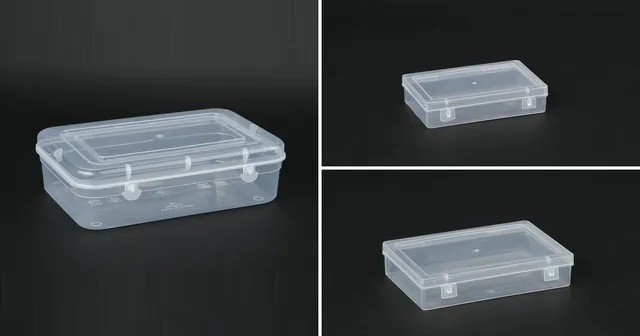
Our imitation jewellery box range runs in six transparent sizes, from two small Kwality boxes to four larger keeper boxes. The dimensions below are from the catalogue, length × width × height.
The "typically used for" column is a guide to how box sizes are commonly matched to pieces. It is not a specification: jewellery designs vary a great deal, and the usable space inside a box is smaller than its outside dimensions. Lay your largest piece flat, measure it, and check it against a sample before you order.
| Box | Code | Size (mm) | Typically used for (guide only) |
|---|---|---|---|
| No. 11 Kwality box | KWB-1 | 80 × 50 × 17 | Stud earrings, a single ring, nose pins |
| No. 22 Kwality box | KWB-2 | 95 × 60 × 18 | An earring pair on a card, a ring, a small pendant |
| No. 33 keeper box | K-1 | 125 × 82 × 30 | Jhumkas and larger earrings, a pendant with chain, a bracelet |
| No. 44 keeper box | K-2 | 165 × 104 × 38 | A pendant set with earrings, a short necklace |
| No. 55 keeper box | K-3 | 183 × 120 × 45 | A necklace set with earrings, a choker set |
| No. 66 keeper box | K-0 | 220 × 145 × 55 | Bridal and long necklace sets, multi-piece sets |
The height matters as much as the footprint. A flat choker lies comfortably in a shallow box; a kundan-style set with raised stones, or a set on a padded card, needs the extra depth of the larger keepers so the lid does not press on the stones.
The same boxes are used outside jewellery retail. Bead sellers, craft suppliers and jewellery makers use them to hold findings, hooks, clasps and loose beads, and small hardware such as screws or watch parts benefits from the same visibility and separation.
The sector these boxes serve
India's imitation jewellery trade is large at home, but the officially reported number is exports. The Gem and Jewellery Export Promotion Council's half-yearly trade report for April to September 2025 puts imitation jewellery exports at US$33.41 million for the six months, provisional, up 9.24% on the same period of 2024.
The same report attributes the growth partly to high gold and silver prices pushing buyers toward imitation pieces, and partly to e-commerce and online retailing widening choice. That second point is the one that changes packaging: more pieces now travel alone, through a courier network, to a customer who judges the seller by how the box arrives.
Retail display and stacking
On a counter or in a showcase, a transparent box works as the display. Customers can compare sets without the shopkeeper unpacking each one, and the piece stays covered while they look.
Rectangular boxes in one family also stack and file well. Keeping the range to a few sizes means a showcase shelf, a stock drawer and a courier carton can all be planned around the same footprints. Before committing to a layout, stack a few filled samples to check they sit squarely under the weight you intend to put on them.
For branding, a printed sticker or insert card is the simplest route. Printing directly on the box is also possible; our custom printed plastic containers guide explains the decoration methods.
Shipping jewellery sold online
A transparent box is a presentation layer, not a shipping carton. For online orders, treat it as the inner pack:
- Fix the piece to an insert so it cannot slide and rub inside the box.
- Put the silica gel sachet or anti-tarnish strip in before closing.
- Place the box in a padded mailer or a small carton with fill, so it does not rattle.
- For the larger keeper boxes, which cover more surface, a rigid outer carton is safer than a soft mailer.
The customer's first view is the box, so a clean, unscratched box matters. Keep the boxes in their cartons until packing rather than loose on the workbench.
Questions buyers ask
Will a plastic box stop imitation jewellery tarnishing completely?
No. It slows tarnish by reducing air exchange and keeping hands and other pieces off the plating. Adding a silica gel sachet or anti-tarnish strip, and keeping boxes in a closed carton or drawer, slows it further.
Should I use silica gel or an anti-tarnish strip?
They do different jobs. Silica gel lowers humidity; an anti-tarnish strip absorbs sulphur gases. For stock that sits through the monsoon, you can use both. Either one stops working once it is saturated, so replace them in slow-moving stock.
Which box suits a bridal set?
Usually the largest keeper, the No. 66 at 220 × 145 × 55 mm, or the No. 55 for a smaller set. Measure the necklace laid flat, including the earrings on their card, and confirm with a sample before ordering in bulk.
Can the boxes be reused?
Yes. A clear box that closes well is useful for storing the piece at home afterwards, and a customer who keeps it keeps your packaging in view.
Can I put my shop name on the box?
A sticker or printed insert is the simplest route. For printing on the box itself, ask whether screen printing or dry offset printing suits the size you have chosen; both are done in-house.
Ordering imitation jewellery boxes
Tell us what you sell, your largest and smallest pieces, and whether they go to a counter or a courier, and we will suggest sizes from the six-box range and send samples from the Dadra works. New customers get a low MOQ on a first order. See the imitation jewellery box range or send your requirements.
Tell us the product, the quantity and the city it ships to.
We reply from the Dadra works with part options and a wholesale quote, usually within one business day.
Keep reading
Custom Printed Plastic Containers: Screen, Offset, Sleeve or Label?
How screen printing, dry offset, shrink sleeves, labels, IML and moulded embossing compare on plastic tubs, plus artwork files and the Indian ink rules.
Plastic Container Manufacturer in India: Types, Uses & Buying Guide
Types of plastic containers and what each trade uses, plus how to judge a manufacturer on tooling, moulding, decoration and packaging waste duties.
Chocolate Box Packaging: Clear Gift Boxes for Hampers, Diwali and Weddings
How to pack chocolate for gifting in India: bloom, heat and humidity, clear rigid boxes vs cartons, inserts, tamper evidence and FSSAI label rules.